Back & neck pain
From muscle strain, disc issues, or posture-related pain, we treat the mechanical cause and rebuild flexibility and control.
Physiotherapy · Scarborough
Reviewed by Maryam Ahankoob, Registered Physiotherapist and clinic lead. Updated November 2026.
Physiotherapy in Scarborough, Ontario, for back pain, a sports injury, post-surgical recovery, or a WSIB or motor vehicle accident claim: you don’t have to just manage it. Physio Cottage’s registered physiotherapists focus on the cause of your pain, not just the symptom.
We serve patients from across Scarborough and east Toronto, including Victoria Village, Wexford, Bendale, Agincourt, L’Amoreaux, and Clairlea, with easy parking and flexible evening and Saturday appointments near Victoria Park & Ellesmere.

Before you book
The practical answers most people want before they call: referral, billing, claims, visit length and how to reach the clinic at Victoria Park and Ellesmere.
Book directly. Ontario physiotherapists are primary access practitioners. Some insurance plans ask for a doctor’s note at claim time, so check your plan.
We bill most extended health plans directly where your plan allows it, and you get a receipt after every visit.
Approved WSIB claims are billed to WSIB, with the reports sent for you. See WSIB physiotherapy.
Treatment plans and billing go to your auto insurer, and we also complete assessments that auto insurers request for a claim. See MVA physiotherapy.
Initial assessment, usually 45 to 60 minutes: $115. Follow-up visit, usually 30 to 45 minutes: $105. No HST on physiotherapy.
Care in English, Farsi and Tagalog. Open Monday to Friday 10 am to 8 pm and Saturday 9 am to 5 pm, closed Sunday.
Physiotherapy is hands-on, exercise-based treatment for pain, injury, and movement problems affecting your muscles, joints, and nervous system. Rather than masking symptoms, a registered physiotherapist assesses how you actually move, identifies the mechanical cause, and builds a plan combining manual therapy, targeted exercise, and education.
It’s the same clinical approach behind our chronic pain program: treat the cause, not just the ache.
Most people don’t need a referral. In Ontario, physiotherapists are primary access practitioners: you can book directly, though some insurers ask for one at claim time.
Fees and pricing
A physiotherapy visit at Physio Cottage costs $115 for your initial assessment and $105 for each follow-up visit. The first appointment is longer because your physiotherapist takes a full history, tests movement, strength and joint function, and explains what is going on before you agree on a treatment plan. Follow-up visits focus on hands-on treatment, exercise progression and checking your progress against the goals you set together. Physiotherapy is covered by most extended health plans, and we bill many of them directly.
$115
First visit, usually 45 to 60 minutes: assessment and treatment plan
$105
Per treatment session, usually 30 to 45 minutes
All prices in Canadian dollars. Your fee is confirmed when you book.
Self-check
You may benefit from a physiotherapy assessment if you experience any of the following.
If any of this sounds familiar, an assessment is a reasonable next step.
Book an assessmentConditions we treat
From muscle strain, disc issues, or posture-related pain, we treat the mechanical cause and rebuild flexibility and control.
Guided rehab that rebuilds strength and range of motion safely after orthopedic or other surgery.
A personalized, graded approach for chronic pain that hasn’t resolved with other treatment.
Targeted release for tight, restricted fascia contributing to chronic muscular pain. See our myofascial release service.
Spinal decompression and traction to relieve pressure on compressed discs and nerves.
Sprains, strains, and overuse injuries get a structured return-to-activity plan through our sports injury physiotherapy program. We also direct-bill approved WSIB and motor vehicle accident (MVA) claims, so you can focus on recovery rather than paperwork.

Your first visit
A real assessment before a real plan, never a generic exercise sheet.
Medical history, posture, and movement patterns, to find the actual cause of your pain.
A treatment plan built around your goals: injury recovery, pain management, or mobility.
Hands-on manual therapy and guided exercise, plus a home program to keep you progressing between visits.
Your first session includes treatment. We don’t just assess and send you home: hands-on therapy and guided exercise start on day one.

Who you’ll see
Maryam Ahankoob is the founder and lead physiotherapist at Physio Cottage, registered with the College of Physiotherapists of Ontario, with over 15 years of clinical experience treating patients across Scarborough and Toronto.
Her clinical work centres on chronic pain, sports injury, prenatal physiotherapy and spinal conditions, using manual therapy, electrotherapy and personalized exercise programs aimed at the cause of pain rather than only managing it. She treats patients at the clinic and reviews the clinical information on this page.
Why Physio Cottage
Every plan is built around your goals, not a generic protocol.
Manual therapy and exercise methods grounded in current research.
Personalized care with your physiotherapist, without rushed appointments.
Most extended health plans, plus WSIB and MVA billing.
Evening and Saturday appointments, with easy on-site parking.
Read what patients across Scarborough and east Toronto say on our Google profile.
Insurance, billing & cost
We offer direct billing to most extended health insurance providers, so in many cases you won’t need to pay out of pocket and submit a claim yourself.
We also bill directly for WSIB and motor vehicle accident (MVA) claims where applicable. Our team can help you understand your coverage before your first visit. Call (416) 445-5353 and we can check it with you.
Where our patients come from
Physio Cottage is located near Victoria Park & Ellesmere and welcomes patients from across Scarborough and east Toronto.
How treatment works
Every plan starts with the assessment, and the treatment that follows is chosen for your body, your goals and the time you can realistically commit between visits. Most plans combine several of the methods below. Your physiotherapist explains what each one is for, so you always know why a technique is part of your session.
Hands-on joint mobilization, soft tissue release and stretching to restore movement in stiff joints and tight muscles. Manual therapy is often the first step when pain is limiting how far you can move.
Targeted strengthening, mobility and control exercises, progressed as you improve. This is the part of physiotherapy that carries results beyond the clinic, which is why every plan includes a home program.
Interferential current, TENS and therapeutic ultrasound to help settle pain and muscle guarding, usually alongside manual work and exercise rather than on their own.
Fine needles placed in tight or sensitive tissue to ease muscle tension and pain. Offered when it fits your condition and only with your consent. In Ontario a physiotherapist must be on the College roster for acupuncture, which includes dry needling, before performing it. Read about acupuncture and dry needling at our clinic.
Gentle, controlled traction for disc related back or neck pain and nerve symptoms that travel into the arm or leg. Learn how decompression works.
Supportive taping, advice on braces and orthotics, and plain language education on posture, lifting and pacing so you can protect the progress you make.
Planning your recovery
The honest answer is that it depends on the condition, how long you have had it and how consistently you can do your home program. After your first assessment your physiotherapist gives you a realistic estimate and reviews it with you as you progress. These are typical patterns we see in the clinic, not promises:
If you are not noticing any change after four to six visits, your physiotherapist will say so and adjust the plan or refer you onward. Continuing care that is not helping is not something we do.
Injury claims
A large share of the patients we treat at Victoria Park and Ellesmere come to us after an injury that involves a claim or a return to play decision. Each of these follows its own process, and we handle the paperwork so you can focus on recovery.
Report the injury to your employer, see a doctor and then call us. We are set up to treat approved WSIB claims, submit the treatment plan and progress reports directly, and bill WSIB so there is no cost to you for approved care. WSIB injury rehabilitation.
After a collision in Ontario your auto insurer covers assessment and treatment under the accident benefits schedule. We complete the treatment plan forms, bill the insurer directly and coordinate with your adjuster. Motor vehicle accident rehabilitation. We also complete assessments that auto insurers request as part of an accident claim.
Sprained ankles, pulled hamstrings, runner’s knee, tennis elbow and shoulder overuse injuries are common reasons to start structured rehabilitation early. We plan the return to sport in stages to lower the chance of the injury coming back. Read more about sports injury physiotherapy in Scarborough.
Between visits
A physiotherapy session is typically 30 to 45 minutes, once or twice a week. The other 160 hours of the week matter more. That is why every patient leaves with a short, specific home program: usually three to five exercises that take 10 to 15 minutes, written down or sent to your phone with clear instructions on sets, repetitions and what a normal amount of discomfort feels like.
We keep programs small on purpose. A long list of exercises rarely gets done. As you improve, exercises are swapped or progressed rather than piled on. If something in the program hurts in a way that worries you, stop and tell us at your next visit or call the clinic; adjusting early is normal.
Doing the program consistently gives every visit more to build on. If you are struggling to fit it in, say so. Your physiotherapist would rather shorten the program than have you skip it.
Honest advice
Physiotherapy is the right starting point for most muscle, joint, nerve and movement problems, and in Ontario you can book directly without a referral. There are situations where you should see a doctor or go to an emergency department first, and we will tell you so if you call us with one of them:
Once a doctor has ruled out anything serious, physiotherapy is usually the next step, and we can start rehabilitation as soon as you are cleared.
Choosing the right care
Physio Cottage offers all three under one roof, and patients often ask which to start with. A simple guide:
You have an injury, pain that limits movement, a surgery to recover from, a claim to manage, or a problem that has lasted more than a few weeks. Physiotherapy gives you an assessment, a plan and an exercise program.
Your main complaint is spinal stiffness, back or neck pain with restricted joint movement, or headaches that seem to come from the neck. Chiropractic care.
Muscle tension, stress related tightness or recovery from training is the main issue and you want hands-on soft tissue work. Registered massage therapy is also a useful addition partway through a physiotherapy plan. Massage therapy.
Not sure? Book a physiotherapy assessment. If another service in the clinic suits you better, your physiotherapist will say so and arrange it.
A good physiotherapist in Scarborough should assess you properly, explain what is going on in plain words and give you a plan you can follow at home. At Physio Cottage every patient sees a registered physiotherapist, one on one, for the whole visit.
Knee, hip, hand and spine arthritis is usually managed with a mix of strength work, joint mobility and pacing. Your physiotherapist sets a program that fits your day so walking, stairs and everyday tasks stay comfortable.
Numbness and tingling in the hand, wrist pain from computer work and elbow pain such as tennis elbow are treated with nerve and tendon loading exercises, workstation changes and, where helpful, a splint.
We bill most extended health insurers directly, along with approved WSIB and car accident claims, so you only pay any amount your plan does not cover. See current fees on our pricing page.
You can confirm that any physiotherapist in Ontario is registered on the College of Physiotherapists of Ontario public register. Only registered members may use the titles physiotherapist, physical therapist or PT, and the College does not allow physiotherapists to use the title “Dr.” when providing or promoting care (Titles, Credentials and Specialty Designations Standard). It also helps to ask how long visits are, who you will see each time and how progress is measured.
Getting here
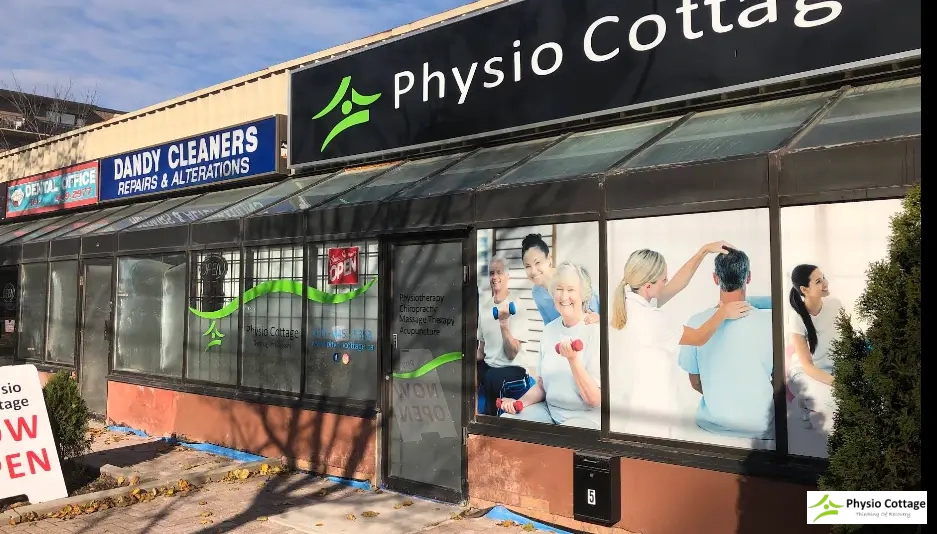
Physio Cottage is at 2231 Victoria Park Ave, Unit 5, Scarborough, ON M1R 1V8, on the east side of Victoria Park Ave between Ellesmere Rd and York Mills Rd. There is on-site parking at the door, which matters when you are arriving with a sore back or on crutches. By transit, the TTC 24 Victoria Park and 924 Victoria Park Express stop at Pachino Blvd, about 100 m away; route 24 runs between Victoria Park Station on Line 2 and Steeles Avenue East. Route 95 York Mills runs along Ellesmere Rd and stops at Victoria Park Ave, about 450 m south (route details on ttc.ca). By car, Highway 401 exit 376 (Victoria Park Ave) is about 1 km north and the Don Valley Parkway is minutes away for patients coming from North York, East York, Markham or the rest of Scarborough. Coming from North York or Markham? See directions for North York patients and Markham patients.
We are open Monday to Friday from 10am to 8pm and Saturday from 9am to 5pm, with evening and Saturday appointments for patients who work during the day. Same-day or next-day appointments are sometimes available for new injuries; call (416) 445-5353 and we will find the earliest slot.
Care is available in English, Farsi and Tagalog. Tell us your preferred language when you book.
Conditions we treat
Below are the problems patients in Scarborough and east Toronto most often bring to us. If yours is not listed, call and ask; the assessment will tell us whether physiotherapy is the right fit.
Low back pain, sciatica, disc bulges, neck pain and stiffness, whiplash after a collision, postural strain from desk work, and headaches that start in the neck. Treatment combines manual therapy, decompression where appropriate and a progressive core and mobility program.
Rotator cuff strains, frozen shoulder, shoulder pain at night, tennis and golfer’s elbow, carpal tunnel symptoms and wrist sprains. Shoulder rehabilitation is staged so you regain range before strength, which helps protect the shoulder while it recovers.
Knee pain when walking or climbing stairs, runner’s knee, meniscus and ligament injuries, hip bursitis and buttock pain when sitting, ankle sprains, Achilles tendinopathy and plantar fasciitis. Lower limb plans focus on load management and strength through the whole chain. Long-standing tendon and heel pain may also be treated with shockwave therapy.
Knee and hip replacements, ACL reconstruction, rotator cuff repair, fracture fixation and spinal surgery. We follow your surgeon’s protocol and keep you moving safely through each phase. When to start physiotherapy after surgery.
Osteoarthritis of the knee, hip, hands and spine, balance concerns and falls prevention, loss of strength after illness or inactivity, and mobility after a stroke or with Parkinson’s disease. Programs are gentle, progressive and set for your age and health.
Vestibular physiotherapy for problems such as BPPV and persistent dizziness, balance problems and headaches after a concussion, jaw (TMJ) pain and clicking, and nerve related pain such as sciatica or pins and needles in the hands. Each has its own assessment and treatment path. Read how physiotherapy addresses dizziness and vestibular problems.
Services and rehabilitation
Physio Cottage offers physiotherapy, massage therapy, chiropractic care, acupuncture and injury rehabilitation at 2231 Victoria Park Ave, Unit 5. Every service starts with a one-to-one assessment and a plan built around your goals, and your physiotherapist can bring in another service in the clinic when it fits your plan.
Rehabilitation in Scarborough. We are an outpatient clinic: you come in for appointments and go home the same day. Rehabilitation here covers recovery after injuries, surgery, car accidents and workplace injuries, chronic pain and age-related loss of strength or balance. Inpatient rehabilitation, such as a hospital stay after a stroke, is arranged by your hospital team. After an overnight hospital stay or day surgery you may qualify for government-funded physiotherapy at a publicly funded clinic; Physio Cottage is a private clinic, and many patients use extended health benefits here.
Care for pain that lasts beyond the usual recovery period or comes with a long-term condition such as arthritis, using graded activity and pacing. Chronic pain treatment
Registered massage therapists (RMTs) treat muscle tension, stress-related tightness and training recovery, on its own or alongside physiotherapy. Massage therapy
Chiropractic care for back, neck and joint pain, coordinated with your physiotherapy plan when you use both. Chiropractic care
Acupuncture based on Traditional Chinese Medicine, and dry needling for tight or sensitive muscle, on its own or with physiotherapy. Acupuncture and dry needling
Vestibular physiotherapy for BPPV, ongoing dizziness and balance problems, and graded rehabilitation after a concussion. Vestibular and concussion physiotherapy
Physiotherapy for jaw pain, clicking and stiffness, with gentle joint mobilization, soft tissue work, jaw and neck exercises and advice on habits such as resting the jaw. TMJ physiotherapy for jaw pain
Treatment for pain from tightness in muscles and the thin connective tissue around them, known as fascia. Myofascial release
Non-surgical traction that gently stretches the spine for disc-related back or neck pain and nerve symptoms; a session usually lasts 15 to 25 minutes. Spinal decompression and traction
Radial shockwave for plantar fasciitis, tennis elbow and long-standing tendon pain, given within a physiotherapy visit and paired with an exercise plan. Shockwave therapy
Gentle, light-touch hands-on treatment focused on the head, spine and surrounding tissues, done fully clothed. Craniosacral therapy
Assisted stretching to improve flexibility, range of motion and recovery after training or long days at a desk. Stretch therapy
Interferential current, TENS and therapeutic ultrasound to help settle pain, used alongside manual therapy and exercise rather than on their own.
Sprains, strains, tendon pain and overuse injuries, with a staged plan back to training and competition. Sports injury physiotherapy
Physiotherapy for workplace injuries within the WSIB system in Ontario, with billing to WSIB for approved care and planning for your return to work. WSIB injury rehabilitation
Care after a collision, including whiplash and soft tissue injuries, with treatment plans, insurer billing and assessments requested by auto insurers. Car accident physiotherapy
Physiotherapy for eligible refugees and refugee claimants covered by the Interim Federal Health Program (IFHP); we confirm eligibility and bill the program for approved visits. Refugee physiotherapy
Rehabilitation after joint replacement, ACL reconstruction, rotator cuff repair, fracture fixation and spinal surgery, following your surgeon’s protocol. When to start after surgery
Strength and balance programs for older adults, people recovering from illness and anyone who has had a fall, planned around daily tasks such as stairs and walking outdoors.
Custom foot orthotics, plus orthopedic shoes sold and fitted at the clinic, when foot position or footwear is part of your pain. Custom orthotics
Knee, back, wrist and other braces fitted at the clinic to support an injured or unstable joint while you rehabilitate. Orthopedic braces
Compression stockings and socks fitted at the clinic for swelling, circulation and recovery. Compression stockings and socks
Fees for every service are on our pricing page, and items available at the clinic are listed on our products page.
Questions patients ask
Reviewed by Maryam Ahankoob, Registered Physiotherapist. Updated 3 November 2026.
In most cases, no. Physiotherapists in Ontario are primary access practitioners, so you can book directly. Some insurance plans may still request a referral for reimbursement, so check with your provider, or call us and we’ll help confirm.
Book an assessment when pain or stiffness has lasted more than a few days, keeps coming back, limits work, sleep or sport, or follows an injury, a fall, a car accident or surgery. You do not need to wait for it to become severe. If you have warning signs such as loss of bladder control, chest pain or a suspected fracture, see a doctor or go to emergency first.
Your first assessment is longer, usually 45 to 60 minutes, so we can take a full history and examine you properly. Follow up treatments are typically 30 to 45 minutes depending on your plan.
Your physiotherapist takes a full history, checks how you move, tests strength, joint range and the nerves where relevant, and explains what they think is going on in plain language. You agree on a plan and goals together, and treatment usually starts the same day, with a short home program to take away.
Bring your health card or photo ID, your extended health insurance card for direct billing, any imaging reports or surgical notes, and your WSIB or auto insurance claim number if your visit is part of a claim. A list of medications and a note of what makes your symptoms better or worse also helps.
Wear comfortable clothing that lets your physiotherapist see and move the area being treated: shorts for a knee, hip or ankle, and a tank top or sports bra for a shoulder, neck or upper back. Bring running shoes if your problem involves walking, running or your feet. We can provide a gown or towel if needed.
We offer evening and Saturday appointments, and same-day or next-day openings are sometimes available. Call the clinic directly to check current availability.
Yes. The clinic is open Monday to Friday from 10 am to 8 pm and Saturday from 9 am to 5 pm, and closed on Sunday. Evening and Saturday appointments are often the first to fill, so book a few days ahead if you need one of those times.
Yes. Continuity matters, so you are booked with the same physiotherapist throughout your plan unless you ask to change or your therapist is away.
Care is available in English, Farsi and Tagalog. Let us know your preferred language when you book so we can schedule you with the right person.
The TTC 24 Victoria Park and 924 Victoria Park Express stop at Victoria Park Ave and Pachino Blvd, about 100 m from 2231 Victoria Park Ave; route 24 runs from Victoria Park Station on Line 2. Route 95 York Mills runs along Ellesmere Rd and also stops at Victoria Park Ave. Check current routes on ttc.ca.
Yes. There is on-site parking at the door of 2231 Victoria Park Ave, Unit 5, which helps when you arrive with a sore back, on crutches or after surgery. Unit 5 is wheelchair accessible.
Physiotherapy appointments at Physio Cottage take place at the clinic at 2231 Victoria Park Ave, Unit 5. If getting to the clinic is hard, call (416) 445-5353 to talk through your options. If you are 65 or older and need physiotherapy at home, Ontario Health atHome (1-833-515-1234) can tell you whether you qualify for government-funded in-home physiotherapy (ontario.ca).
An initial physiotherapy assessment is $115 and usually takes 45 to 60 minutes. Each follow-up visit is $105 and usually takes 30 to 45 minutes. Physiotherapy is not subject to HST. Fees for every service are on our pricing page.
Most extended health insurance plans cover physiotherapy, and we offer direct billing to most major providers. Plans differ in their yearly maximum, the percentage they pay and whether they want a doctor’s note, so check your booklet or call us and we will check with you.
Yes. We bill directly for approved WSIB workplace injury claims and MVA claims, so you don’t need to pay upfront and file a claim yourself.
Yes. Call (416) 445-5353 with your plan details and we will check your physiotherapy coverage with you before your first visit, so you know what your plan pays and whether anything is left for you to pay.
Yes. You get an official receipt after every appointment, which you can send to your insurer or keep for your tax return. When we bill your plan directly, the receipt shows what the plan paid.
No. Physiotherapy, chiropractic care and acupuncture at the clinic are HST-exempt. Massage therapy is taxable, and our massage prices already include HST.
Only for some people, and only at publicly funded clinics. Physio Cottage is a private clinic, so OHIP does not pay for visits here; most patients use extended health benefits. Ontario funds clinic physiotherapy if you are 65 or older, 19 or under, receive Ontario Works or ODSP, or need physiotherapy after an overnight hospital stay or day surgery in the last 12 months (ontario.ca).
People aged 65 or older can get government-funded physiotherapy at a publicly funded community clinic, and those who need it at home can contact Ontario Health atHome at 1-833-515-1234. The clinic assesses whether you qualify. Seniors are also welcome at Physio Cottage as private patients, often using retiree benefits.
Ontario lists publicly funded clinics in its physiotherapy clinic directory on the Get physiotherapy page. You choose a clinic, and that clinic assesses whether you qualify. The province also points to exercise and falls prevention classes through Health811.
If you receive income from Ontario Works or the Ontario Disability Support Program, you can get government-funded physiotherapy at a publicly funded clinic, and the province says an OHIP card is not required in that case (ontario.ca).
Yes. Eligible refugees and refugee claimants covered by the IFHP can receive physiotherapy here. We confirm eligibility before the first visit and bill the program directly for approved treatment. See refugee physiotherapy.
That depends on your problem and your coverage. Many extended health plans pay most or all of a physiotherapy visit, which lowers what you pay. At your first visit your physiotherapist explains the plan, how many visits to expect and how progress will be checked, so you can decide with clear information. If you qualify for government-funded physiotherapy, that is also an option.
A physiotherapist assesses how your muscles, joints and nerves are working, explains the cause of pain or stiffness, and treats it with hands-on therapy, exercise, education and, when useful, tools such as acupuncture or electrotherapy. Read more in what a physiotherapist does.
Physiotherapy is often grouped into musculoskeletal (muscles, joints, sports and work injuries), neurological, cardiorespiratory and paediatric care. Physio Cottage focuses on outpatient musculoskeletal care, including sports injuries, post-surgical rehabilitation, chronic pain and dizziness and balance problems.
Yes. In Ontario, “physiotherapist” and “physical therapist” are both protected titles for the same regulated profession, along with “PT”. Only members of the College of Physiotherapists of Ontario may use them (collegept.org).
Physiotherapy shouldn’t be painful, though some techniques can cause temporary discomfort or soreness, similar to a hard workout. Your physiotherapist works within your comfort level throughout.
Mild soreness for a day after treatment or new exercises is common. Pain that is sharp, worsening or different from your usual symptoms is not, so call us and we will adjust your plan or see you sooner.
Physiotherapy focuses on assessing movement and rebuilding strength, mobility, and function through manual therapy and exercise. Chiropractic care centres on spinal and joint adjustment, and massage therapy focuses on soft-tissue relaxation. Many patients combine services, and our team can recommend the right mix after your assessment.
Yes. Dry needling uses fine needles in tight or sensitive muscle to ease tension and pain. It is offered only when it suits your condition and with your consent. In Ontario a physiotherapist must be on the College roster for acupuncture, which includes dry needling, before performing it (collegept.org).
Yes. Vestibular physiotherapy assesses and treats BPPV, ongoing dizziness and balance problems, and we provide graded rehabilitation for symptoms after a concussion. If dizziness comes with slurred speech, facial weakness or a sudden severe headache, call 911 first. Read how physiotherapy helps dizziness.
A red flag is a sign that a problem may need urgent medical care rather than physiotherapy first. Examples are loss of bladder or bowel control, numbness around the groin, weakness in both legs, chest pain, fever with pain, unexplained weight loss, a possible fracture and sudden calf swelling. Your physiotherapist screens for these at every assessment.
Most muscle and joint problems can be assessed and treated without imaging, and many scan findings also appear in people without pain. If your assessment suggests you need an X-ray, ultrasound or MRI, your physiotherapist explains why and coordinates with your family doctor or nurse practitioner. Read do you need X-rays before physiotherapy.
No. The College of Physiotherapists of Ontario does not allow physiotherapists to use the title “Doctor” or its short form when providing or promoting health services (collegept.org). Physiotherapists at our clinic use the title Registered Physiotherapist.
Search the physiotherapist’s name on the College of Physiotherapists of Ontario public register. It shows whether they are registered to practise, and any conditions on their practice. You can search Maryam Ahankoob there.
Yes, and many patients do. Let us know when you book and we will schedule the two appointments back to back where possible. Each is billed separately to your plan.
Yes. We treat teens with sports injuries and growth related pain, and many of our patients are seniors working on balance, strength, arthritis and recovery after joint replacement.
It depends on your condition, its severity, and your goals. Some patients notice improvement within a few sessions; more complex or long-standing issues take longer. Your physiotherapist outlines an estimated plan after your first assessment.
For a recent injury, visits are often once or twice a week at the start, then spaced out as your home program takes over. After surgery, frequency follows your surgeon’s protocol. Claims follow the plan approved by WSIB or your auto insurer. Your physiotherapist sets a schedule with you and reviews it as you progress.
It depends on the problem, how long you have had it and how consistently you do your home program. Recent sprains and strains often change within the first few weeks, while long-standing pain changes more gradually. If you notice no change after four to six visits, your physiotherapist will say so and adjust the plan or refer you on.
Look for practical signs: less pain with the activities that bothered you, better movement or strength, fewer flare-ups and more confidence doing daily tasks. Your physiotherapist re-checks the measures from your first assessment so progress is not guesswork. Read how to tell if physiotherapy is working.
Usually you can go back to normal light activity. Mild soreness for a day is common, especially after new exercises. Follow the guidance your physiotherapist gives for your condition, keep up the home program unless told to pause, and call if pain is sharp or getting worse. See what to do after a session.
For most muscle and joint pain you can book physiotherapy directly, without a referral. See your doctor first, or go to emergency, if you have red flags such as a possible fracture, loss of bladder or bowel control, chest pain, fever with pain or sudden calf swelling. Your physiotherapist will refer you if something needs medical review.
Timing follows your surgeon’s protocol. Many people start within days or a few weeks of surgery, with early work on swelling, movement and walking, then strength later. Bring your surgical notes and any instructions to the first visit. Read when to start physiotherapy after surgery.
For some conditions, exercise-based rehabilitation is tried before surgery is considered, and some people then find they do not need an operation. Whether that applies to you is a decision for you and your surgeon. Your physiotherapist can explain what rehabilitation involves so you can discuss it. Read can physiotherapy prevent surgery.
Often, yes. A fresh assessment sometimes finds a contributing factor that was missed, or a plan that was not progressed. Bring your previous notes and we will build on what has already been tried.
We are an outpatient physiotherapy and rehabilitation clinic: you come in for one-to-one appointments and go home the same day. We do not provide inpatient rehabilitation, which is arranged through hospitals. After a hospital stay, outpatient physiotherapy is often the next step, and you may qualify for government-funded physiotherapy at a publicly funded clinic.
Report the injury to your employer, get medical attention and then call us; physiotherapy can usually start soon after. Bring your WSIB claim number if you have one. For approved claims we send the reports and bill WSIB directly. See WSIB physiotherapy in Scarborough.
Tell your auto insurer about the accident and get a claim number, and see a doctor if you are hurt. Then book an assessment with us. Your auto insurer covers assessment and treatment under Ontario accident benefits; we complete the treatment plan forms and bill the insurer directly. See car accident physiotherapy.
Yes. Along with treatment, the clinic completes assessments that auto insurers request as part of a motor vehicle accident claim. Call (416) 445-5353 with your claim details and we will tell you what the assessment involves and how it is booked.
Check that the physiotherapist is on the College of Physiotherapists of Ontario public register, then ask how long visits are, whether you see the same person each time, whether you get a written plan and home program, and whether the clinic bills your plan, WSIB or auto insurer directly. Location, parking and evening hours matter too when you need regular visits.
A good physiotherapist assesses you thoroughly, explains the problem in words you understand, sets goals with you, gives you a home program and re-checks progress regularly. They should also tell you honestly if treatment is not helping and refer you on. You should feel free to ask questions at every visit.
Registered physiotherapy, direct billing, and appointments that fit your schedule, right at Victoria Park & Ellesmere.
Monday to Friday 10am to 8pm · Saturday 9am to 5pm · Sunday closed
2231 Victoria Park Ave, Unit 5, Scarborough, ON M1R 1V8
Choosing a physiotherapist is easier when you know what to ask. These questions help you compare clinics in Scarborough:
At Physio Cottage you can ask these questions before you book. Call (416) 445-5353 or book online.
From the blog
Book a physiotherapy assessment online or call the clinic. We are at 2231 Victoria Park Ave, Unit 5, Scarborough, ON M1R 1V8, open Monday to Friday 10am to 8pm and Saturday 9am to 5pm.