
What Causes Sciatica and How Physiotherapy Helps

Short answer: Sciatica is a symptom, not a diagnosis. It is pain, tingling or numbness that travels from the lower back or buttock down the leg when the sciatic nerve is irritated, most often by a slipped (herniated) disc, and also by spinal stenosis, a slipped vertebra or tight buttock muscles. Most sciatica settles in a few weeks to a few months without surgery. Physiotherapy finds the likely source and uses positions that ease the leg pain, nerve glides, strengthening and sitting and lifting advice. Numbness around the genitals or bottom, or new bladder or bowel problems, need emergency care.
Reviewed by Maryam Ahankoob, Registered Physiotherapist, on November 3, 2026. This guide brings together our three earlier sciatica articles.
The sciatic nerve is the longest nerve in the body. It starts from nerve roots in the lower back, runs through the buttock and down the back of each leg to the foot. When something presses on or irritates it, the pain can be sharp enough to stop you mid-step. Many people hope it will simply go away, and many episodes do settle with time. Knowing what is likely causing yours, what helps and which signs need urgent care makes that time shorter and safer.
What sciatica is, and what it feels like
Sciatica describes pain that follows the path of the sciatic nerve. It is not a disease on its own; it is the result of something compressing or inflaming the nerve or its roots. Typical symptoms are:
- Shooting, burning or electric pain from the lower back or buttock down one leg, sometimes to the foot or toes
- Tingling, pins and needles or numbness in the leg or foot
- Weakness in the leg, or a foot that catches when you walk
- Pain that is worse when sitting, bending forward, coughing or sneezing
Sciatica usually affects one side. Not every ache in the back of the leg is sciatica: pain from a strained hamstring or a stiff hip often stays local and does not bring tingling or numbness below the knee. If you are unsure which one you have, our guide on muscle pain versus nerve pain explains the differences.
What causes sciatica
A slipped (herniated) disc is the most common cause of sciatica, followed by spinal stenosis, spondylolisthesis and back injuries. In clinic we also see buttock and pelvic sources that behave like sciatica. The clues below are patterns physiotherapists look for; only an assessment can tell them apart.
Disc herniation or bulge
The soft centre of a disc pushes out and irritates a nerve root, usually low in the spine. Leg pain that is worse with bending forward, sitting, coughing or sneezing, and easier lying down, often points to a disc. Our herniated disc guide covers this cause in detail.
Spinal stenosis
The space around the nerves narrows, often with age. A typical pattern is leg pain or heaviness that builds after a few minutes of walking and eases when you sit or lean forward, for example on a shopping cart. Cycling is often easier than walking because the spine bends forward.
Spondylolisthesis
One vertebra has slipped forward on the one below. Pain is often worse when you lean back or stand for long periods, and there may be a catch or deep ache when you stand up from sitting.
Piriformis and deep buttock pain
The piriformis muscle sits deep in the buttock close to the sciatic nerve. When it is irritated, pain sits deep in the buttock and can spread down the back of the thigh, which is easily mistaken for a disc problem. Long sitting, driving and sitting on a wallet in a back pocket often make it worse.
Sacroiliac joint
Pain from the joint between the spine and pelvis is usually one-sided, over the dimple at the top of the buttock, and can spread into the back of the thigh, rarely past the knee. Rolling in bed, getting out of a car and standing on one leg are common triggers.
Pregnancy
Changes in posture and in the ligaments of the pelvis can irritate the nerve or the sacroiliac joints, especially later in pregnancy. Positions, gentle exercise and support belts are often used; check with your doctor or midwife first. See physiotherapy for pregnant women.
When sciatica needs emergency care
Go to the nearest emergency department or call 911 if you have any of these:
- Numbness around or under your genitals, or around your bottom
- Difficulty starting to pee, being unable to pee, or not being able to control when you pee
- Not noticing when you need to poo, or not being able to control it
Also get urgent medical help for weakness in both legs, leg weakness that is getting worse, back pain with fever or feeling unwell, or pain after a serious fall or car accident. These are not cases to wait out or to start with physiotherapy.
How long sciatica lasts
Sciatica usually gets better in a few weeks to a few months, although it can sometimes last longer. Recovery is rarely a straight line, and good days and flare-ups are both normal. A common pattern looks like this:
- First one to two weeks: settling the pain with positions that ease the leg symptoms, short walks, gentle nerve glides and short rests
- Weeks two to six: building core, hip and back strength and getting back to normal activities
- After six weeks: restoring full fitness, lifting and sport, and keeping the habits that protect your back
Signs you are heading the right way include the leg pain moving back up toward the buttock or lower back, being able to walk or sit for longer, and better sleep.
How physiotherapy helps sciatica
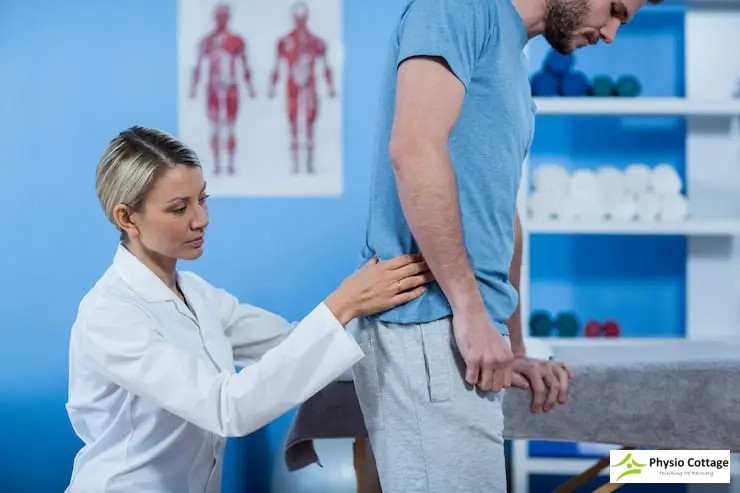
Exercise and staying active come first for low back pain with or without sciatica, and hands-on treatment is used as part of a plan that includes exercise. A physiotherapy plan usually combines:
- Assessment: history, strength, reflexes and sensation, and movement testing to find positions that ease or increase the leg symptoms. For many disc-related cases, repeated movements in one direction (often gentle backward bending) ease leg pain, and these become the first home exercises.
- Nerve glides: gentle movements that slide the nerve without stretching it hard, such as the seated slider described below.
- Hands-on care: joint mobilization and soft tissue work to ease guarding and stiffness, always paired with exercise.
- Strength: deep core, glute and hip work so the back handles load again.
- Sitting, driving and lifting advice: the habits that keep re-irritating the nerve, especially for people who sit for long hours at a desk or behind the wheel.
At Physio Cottage this happens through physiotherapy in Scarborough with a one-to-one assessment, and you can book without a doctor’s referral. Some people with disc-related sciatica also use spinal decompression and traction, massage therapy for tight buttock and back muscles, or acupuncture or dry needling. The evidence on needling for sciatica is mixed, so your physiotherapist can explain whether it is worth trying in your situation.
Medicines and injections
Pain medicines and injections can ease pain for a while and make it easier to move, and those decisions belong with your doctor or pharmacist. They do not change the sitting, lifting and strength habits that often keep the nerve irritated, which is why exercise and movement retraining still matter alongside them.
Exercises to discuss with your physiotherapist
These are common starting exercises. Move gently, and stop any exercise that makes the leg pain, tingling or numbness spread further down the leg. Pain that moves back toward the spine is usually a good sign. Ask your physiotherapist which ones suit your cause.
- Pelvic tilts: lie on your back with knees bent and feet flat. Tighten your lower stomach and gently flatten your back into the floor, hold for 5 seconds, relax. Repeat 10 to 15 times.
- Knee-to-chest: lying on your back, bring one knee toward your chest with both hands, hold 20 to 30 seconds, then switch. Repeat 3 to 5 times each side. Skip it if bending forward makes your leg pain worse.
- Piriformis stretch: lying on your back with both knees bent, cross the sore leg over the other thigh, hold behind the lower thigh and gently draw it toward you for 30 seconds. Repeat 3 to 5 times each side.
- Cat-cow: on hands and knees, slowly arch and then round your back 10 to 15 times to ease stiffness.
- Seated nerve glide (slider): sit tall, then straighten the sore knee while lifting your head to look up, and bend the knee as you bring your chin down. Move smoothly, 5 to 10 times, without forcing it.
- Glute bridges: lying on your back with knees bent, press through your heels and lift your hips, hold 3 to 5 seconds, lower. Repeat 10 to 15 times.
- Bird-dog and side plank: once pain settles, these build the trunk and hip strength that helps prevent flare-ups. Start with short holds of a few breaths.
Strong hamstring stretches can irritate a sensitive nerve, so gentle nerve glides and positions that ease the leg pain are usually a better start. Our guide to common physiotherapy exercises shows how plans progress.
Easing sciatic pain at home
Stay active, carry on with normal activities as much as you can and start gentle movement as soon as possible; a heat pack on the painful area can help. While you wait for an assessment:
- Positions: lie on your back with pillows under your knees, or on your side with a pillow between your knees. Avoid deep forward bends and sitting with crossed legs.
- Heat or ice: use whichever feels better, for 15 to 20 minutes with a cloth between the pack and your skin. Heat relaxes tight muscles, but some people find it increases nerve pain.
- Walking: short, flat walks through the day help more than long ones that flare the leg pain.
- Rest: a day or two of easier activity can help, but long bed rest stiffens the back and tends to slow recovery.
Sitting, sleeping and daily habits
- Get up and move every 30 to 45 minutes when sitting; set a reminder if you work at a desk
- Use a small cushion or rolled towel behind your lower back and keep your feet flat on the floor
- Take your wallet out of your back pocket before you sit or drive
- In the car, bring the seat close enough that your knees are not straight and your back is supported
- Sleep on your side with a pillow between your knees, or on your back with pillows under your knees, rather than on your stomach
- Lift with your knees bent and the load close to your body, hinging at the hips
- Switch sides when carrying a child or a heavy bag, or use a carrier
- Avoid long spells in deep, soft chairs and long sessions on the toilet with your phone
- Try a few gentle movements, such as cat-cow and nerve glides, before getting out of bed if mornings are stiff

Why sciatica keeps coming back
Flare-ups often return when the triggers stay the same: long hours of slumped sitting, weak trunk and hip muscles, or repeated bending and lifting without recovery time. A sensitive nerve also reacts to smaller movements over time. Changing the daily triggers and building strength gradually is what usually breaks the cycle, which is why the home program matters as much as the clinic visits.
What to bring to your first physiotherapy visit
- A list of your medicines and any imaging reports you already have
- Notes on which positions and activities ease or worsen your pain
- Comfortable clothing that lets you move and gives access to your lower back and legs
- Your extended health benefits details if you plan to claim; see how to check your coverage and our prices
Sciatica questions
How long does sciatica usually last?
Sciatica usually gets better in a few weeks to a few months, although it can sometimes last longer. Disc-related cases and long-standing symptoms often take longer than a first, mild episode.
Can I just wait for it to go away?
Many episodes do settle with time. Staying gently active helps more than resting, and an assessment is worth booking if pain is severe, keeps returning or is not easing after a few weeks. Emergency signs such as numbness around the genitals or bottom, or bladder or bowel changes, need care straight away.
Is walking good or bad for sciatica?
Short, frequent, flat walks are good for most people. Long walks that make the leg pain spread or build are not. With spinal stenosis, walking often brings on symptoms and short walks with rests, or cycling, may be easier.
Is bed rest good for sciatica?
Not for long. A day or two of easier activity can help, but staying active within comfort usually helps more, and carrying on with normal activities as much as possible helps most people.
Should I stretch if it hurts?
Stretch gently and stop if the leg pain, tingling or numbness spreads further down the leg. Strong hamstring stretches can irritate a sensitive nerve; nerve glides and positions that ease leg pain are usually a better start.
Can a heating pad or TENS machine help?
Heat often relaxes tight muscles, although some people find it increases nerve pain; use whichever of heat or ice feels better. Heat and TENS can give short-term relief but do not change the cause, so they work best alongside exercise.
Can sciatica be treated without surgery?
Most sciatica improves without surgery. Surgery is considered when symptoms are severe, not improving with other treatment, or there is worsening weakness or numbness, and that decision is made with your doctor and a surgeon.
Do I need an MRI for sciatica?
Usually not at first. A scan is not recommended for recent low back pain unless there are red flags. Imaging is used when red flags are present or surgery is being considered.
Can physiotherapy help sciatica in pregnancy?
Physiotherapy can be adapted during pregnancy with positions, gentle exercise and support belts. Check with your doctor or midwife first, and tell your physiotherapist how many weeks pregnant you are.
Do I need a referral to see a physiotherapist for sciatica?
No. In Ontario you can book a private physiotherapy assessment without a doctor’s referral, although some insurance plans ask for a doctor’s note before they reimburse, so check your plan.
Related guides
- Knee Pain When Walking? 7 Hidden Causes You Should Know
- Physiotherapy for Knee Pain: Causes and Treatment Options
- Physiotherapy for Shoulder Pain: Causes, Treatment, Recovery
Book your physiotherapy assessment
Physio Cottage, 2231 Victoria Park Ave, Unit #5, Scarborough, ON M1R 1V8. Open Monday to Friday 10am to 8pm and Saturday 9am to 5pm. Direct billing where your plan allows.
- One-to-one assessment with a registered practitioner
- Evening and Saturday appointments
- Parking at Victoria Park and Ellesmere

About the author and clinical reviewer
Maryam Ahankoob, Registered Physiotherapist at Physio Cottage, 2231 Victoria Park Ave, Unit #5, Scarborough, ON M1R 1V8. Questions about this article or your own symptoms? Call (416) 445-5353 or learn more about our clinic.