When you wake up with a shooting pain in your lower back or struggle to regain mobility after surgery, your first thought is usually about getting better. But in Ontario, that thought is almost immediately followed by a nagging question: “How much is this going to cost me?” It’s a stressful crossroad where physical agony meets financial anxiety. If you are searching for physiotherapy scarborough, you are likely trying to balance a tight budget with the need for high-quality care.
There is a common myth floating around that because we live in Canada, our healthcare system is a “free for all” that covers every stretch, needle, and adjustment. Unfortunately, that is far from the reality of the situation. While the Canada Health Act ensures we don’t pay to see a doctor or stay in a hospital, the rules for “rehabilitative” care like physiotherapy are far more nuanced and, frankly, a bit restrictive.
This guide is designed to be your strategic roadmap. We aren’t just going to list rules; we are going to dive deep into how you can leverage the system to ensure you aren’t paying more than you have to for your recovery. At Physio Cottage, we believe that transparency is the first step toward healing, so let’s pull back the curtain on who actually foots the bill for your treatment.
Reality Check 1: OHIP Coverage – The “Exclusive Club”
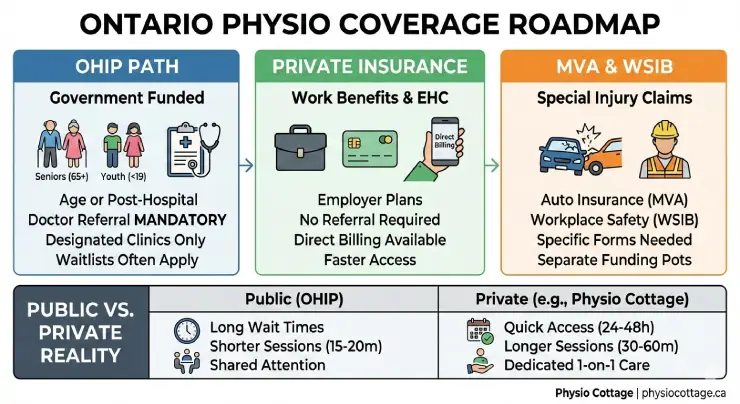
The Ontario Health Insurance Plan (OHIP) does cover physiotherapy, but it’s not as simple as showing your green health card at any clinic. To access government-funded treatment, you have to fit into specific “buckets” of eligibility, making it feel like an exclusive club where the bouncers are very strict about the guest list.
The Age Gap: Why most Ontarians aged 19–64 are excluded
For the vast majority of working-age adults in Ontario, OHIP-funded physiotherapy is essentially a closed door. If you are between the ages of 19 and 64, the government assumes you either have workplace benefits or can afford to pay out-of-pocket. However, if you are 65 or older, or 19 and younger, the province recognizes a higher level of vulnerability and provides coverage through community clinics. This age-based gatekeeping is often the biggest shock to patients who have spent years paying into the tax system, only to find they are “too young” for public rehab.
The “Overnight Stay” Rule: How post-hospitalization qualifies you
There is one significant exception to the age rule: hospitalization. If you have been admitted to a hospital for an overnight stay for a condition that now requires physiotherapy (such as a hip replacement or major abdominal surgery), OHIP may cover your initial rehabilitation regardless of your age. This is categorized as “post-acute” care. The catch? You usually have to start this treatment within a very specific window—often 48 hours to a few weeks after discharge—to qualify for the government-funded stream.
Social Assistance Pathways: ODSP and Ontario Works eligibility
Equity in healthcare is a major concern, and Ontario does provide a pathway for those on social assistance. If you are currently receiving benefits from the Ontario Disability Support Program (ODSP) or Ontario Works, you are eligible for OHIP-funded physiotherapy. This is a vital lifeline for those needing refugee physiotherapy scarborough or support while navigating financial hardship. It ensures that your ability to walk or work isn’t dictated solely by the balance in your bank account.
The Golden Ticket: Why a Doctor’s Referral is non-negotiable for OHIP
Even if you meet all the age or social criteria, you cannot simply walk into an OHIP clinic and demand treatment. You need a “Golden Ticket”—a formal referral from a physician or a nurse practitioner. This referral must state that the treatment is medically necessary. Without this piece of paper, the clinic cannot bill the Ministry of Health, and you might find yourself facing an unexpected bill.
The Fine Print: Hidden Limitations of Government-Funded Physio
Understanding that you are “eligible” for OHIP is only half the battle; the other half is dealing with the reality of how that care is delivered. Publicly funded physiotherapy operates under a model that is vastly different from the personalized, one-on-one sessions you might expect at a private scarborough physiotherapy clinic.
Not All Clinics Are Created Equal: OHIP-Designated Clinics
One of the most frustrating hurdles for patients is realizing that not every clinic is allowed to bill OHIP. The government has a specific list of “Publicly Funded Physiotherapy Clinics.” If you go to a high-end boutique clinic down the street, even if you are 70 years old with a doctor’s note, they may not be an OHIP-designated site. This often leads to patients traveling long distances across the GTA just to find a facility that accepts their health card.
The “Episode of Care” Model: The hard truth about session limits and duration
OHIP does not pay per visit; they pay per “Episode of Care.” This is a flat fee the government pays the clinic to treat a specific injury or condition. Because the funding is limited, these clinics are often forced to see multiple patients at once or utilize physiotherapy assistants (PTAs) for the bulk of the treatment. You might find that your “coverage” ends after just a few weeks, even if you still feel pain, because the “episode” is technically closed in the eyes of the Ministry.
The Waiting Game: Dealing with long waitlists for public treatment
The most significant “hidden cost” of OHIP physiotherapy is time. Because the number of designated clinics is capped, the demand far outweighs the supply. It is not uncommon to wait weeks or even months for an initial assessment. When dealing with chronic pain treatment scarborough, waiting three months can mean the difference between a quick recovery and a lifetime of compensatory injuries.
Also Read: Affordable Physio in Scarborough: Insurance, Cost, and Tips
Reality Check 2: Private Insurance (EHC) – The Middle-Class Savior?
For those who don’t qualify for OHIP, Extended Health Care (EHC) through an employer is the most common way to fund treatment. While it offers much more flexibility than the public system, it comes with its own set of rules that can feel like deciphering an ancient scroll.
Decoding Your Policy: Annual caps, deductibles, and percentage coverage
Most insurance plans don’t offer “unlimited” physiotherapy. Instead, they give you an annual cap—perhaps $500 or $1,000 per year. Some plans also operate on a percentage basis, meaning they pay 80% and you pay the remaining 20%. Before you book your first session with registered physiotherapists scarborough, it is crucial to log into your insurer’s portal (like Sun Life, Manulife, or Canada Life) and see exactly what your “paramedical” limits are.
Do You Need a Doctor’s Note for Private Insurance?
This is a point of massive confusion. In Ontario, physiotherapists are “primary healthcare providers,” meaning the law says you don’t need a doctor’s note to see them. However, your insurance company is a private corporation, and they make their own rules. Many “standard” plans still require a physician’s referral before they will reimburse you for the cost of the session. Always check your specific policy wording to avoid having a claim denied on a technicality.
The Convenience of Direct Billing: How to avoid paying out-of-pocket
Nobody likes the “pay and chase” method where you pay the clinic and wait weeks for the insurance company to mail you a check. At Physio Cottage, we prioritize direct billing. This means we submit the claim to your insurance company in real-time while you are at the clinic. You only pay the “co-pay” amount that isn’t covered. It’s a seamless way to integrate holistic physiotherapy scarborough into your life without ruining your monthly cash flow.
Special Scenarios: When It’s Not Illness or Age
Sometimes, the “who pays” question changes because of how you got hurt. In Ontario, there is a hierarchy of payers. If a car or a workplace is involved, OHIP and private insurance often take a backseat.
Motor Vehicle Accidents (MVA): Why your car insurance pays before OHIP
If you are injured in a car accident in Ontario, your auto insurance is the primary payer for your rehabilitation. This is true even if you were a passenger or a pedestrian. You have access to “Statutory Accident Benefits,” which cover physiotherapy, massage therapy scarborough, and even psychological counseling if needed. The system is complex, requiring OCF forms and disability certificates, but it generally offers much higher funding levels than a standard workplace plan.
Workplace Injuries (WSIB): The specific rules for injured workers
If you hurt your back lifting a heavy box at work or developed carpal tunnel at your desk, the Workplace Safety and Insurance Board (WSIB) is responsible for your care. WSIB has specific “Programs of Care” (POC) for things like lower back pain or shoulder injuries. The beauty of a WSIB claim is that the treatment is usually 100% covered, including any necessary equipment, provided you see a clinic that is registered with the WSIB system.
Also Read: The Impact of Early Physiotherapy: Timely Care and Better Health
Head-to-Head: Public vs. Private Physiotherapy Clinics
Choosing between an OHIP-funded clinic and a private clinic like Physio Cottage often comes down to a trade-off between “free” and “quality.” While the public system is a necessary safety net, the experience of care is drastically different.
| Feature | OHIP-Funded Clinics | Private Clinics (Physio Cottage) |
| Wait Times | Weeks to Months | Usually 24–48 Hours |
| Session Length | 15–20 mins with PT | 30–60 mins one-on-one |
| Attention | Often shared with other patients | 100% focused on you |
| Referral Needed | Mandatory | Not required (unless by insurer) |
| Technology | Basic equipment | Advanced tools (Laser, Shockwave, etc.) |
If you are dealing with a complex issue that requires specialized techniques like myofascial release scarborough, the private route is often more effective. In a private setting, your therapist has the time to look at your body as a whole system, rather than just treating a “body part” within a strict 15-minute window. This level of Chiropractic Care Scarborough and physiotherapy integration is what often leads to faster, more permanent results.
The Hybrid Strategy: How to Maximize Your Care
What if you have a little bit of insurance, but not enough for a full recovery? Or what if you qualify for OHIP but the wait is too long? This is where a “Hybrid Strategy” comes into play. You don’t have to choose just one path.
Can You Mix OHIP and Private Insurance?
Technically, you cannot use both OHIP and private insurance for the same session. However, you can use OHIP for your basic functional recovery and then switch to your private insurance for more specialized treatments like acupuncture scarborough. Many patients find that the public system gets them back to walking, but the private system gets them back to running marathons or playing with their grandkids without pain.
No Insurance? No Problem: Out-of-pocket rates and student clinics
If you have zero coverage, don’t lose hope. Many private clinics offer sliding scales or “block-booking” discounts to make care more affordable. Additionally, you might look into university-affiliated student clinics where supervised students provide care at a fraction of the cost. At Physio Cottage, we always encourage patients to speak with us about their financial constraints; we can often design a “home exercise heavy” program that requires fewer in-person visits, making your recovery more affordable.
FAQ
Does OHIP cover massage therapy or chiropractic care?
No. OHIP specifically covers physiotherapy under the criteria mentioned above. It does not provide coverage for Registered Massage Therapy (RMT) or Chiropractic care, though these are almost always covered by private Extended Health Care (EHC) plans.
How much does a private physiotherapy session cost in Ontario?
Rates vary by clinic and location, but typically, an initial assessment in the GTA ranges from $95 to $150, and follow-up treatments range from $70 to $110 per session.
How do I find an OHIP-funded clinic near me?
You can visit the Ontario Ministry of Health website and search for “Publicly Funded Physiotherapy Clinics” or ask your family doctor for a list of designated community clinics in your specific postal code.
Can I use my insurance for acupuncture or bracing?
Most EHC plans have a separate “pot” of money for acupuncture (often under a “Physiotherapy” or “Acupuncturist” heading) and a “Medical Supplies” category for custom bracing or orthotics.
What happens if my insurance runs out before I’m healed?
Once your benefits are exhausted, you can continue treatment as an out-of-pocket patient. We recommend checking if you can claim these expenses on your annual tax return under “Medical Expenses” to get some of that money back.
Which Path is Right for You?
Deciding how to fund your recovery shouldn’t be harder than the recovery itself. To help you decide, ask yourself these three questions:
- Am I in a high-priority group? (Under 19, over 65, or recently had surgery?) If yes, start by exploring OHIP.
- Do I have workplace benefits? If yes, a private clinic will offer faster, more personalized care with minimal out-of-pocket costs.
- Was I injured at work or in a car? If yes, ensure you have a claim number so your treatment can be fully covered by WSIB or your auto insurer.
At Physio Cottage, we are experts at helping our neighbors navigate these messy financial waters. you need a scarborough physiotherapy clinic that understands the nuances of MVA claims to compliment your healing, we are here to help.
Stop guessing about your coverage and start focusing on your health. [Click here to Book Your Consultation at Physio Cottage Today] or call us to have our administrative team verify your insurance benefits for you!