
Let’s be honest—most of us didn’t sign up for a job that slowly wrecks our bodies. Yet here we are, hunched over keyboards, squinting at screens, wondering why our necks feel like rusted hinges by 3 PM.
If you work a desk job in Scarborough or anywhere in the Greater Toronto Area, chances are you’ve felt that familiar ache creeping into your shoulders. Maybe your lower back protests every time you stand up. Perhaps your wrists tingle after a long typing session.
You’re not imagining things. And no, you’re not just “getting older.”
The truth is, our bodies weren’t designed for eight-plus hours of sitting. We evolved to move, hunt, gather—not to freeze in ergonomically questionable office chairs while responding to emails.
But here’s the good news: you don’t need a complete career change to feel better. Simple physiotherapy exercises, done consistently at your desk, can dramatically reduce pain and prevent long-term damage. This guide walks you through exactly what to do, when to do it, and why it actually works.
For those dealing with persistent discomfort, chronic pain treatment Scarborough specialists often trace the origin back to years of accumulated postural stress.

Common Physical Problems Faced by Office Workers
Before diving into solutions, let’s map out exactly what goes wrong. Knowing your enemy helps you fight smarter.
Neck Pain and Tension
That tight, burning sensation at the base of your skull? Classic desk worker signature. When your head pushes forward—even just an inch—your neck muscles work overtime to support it. For every inch of forward head posture, your neck bears an extra 10 pounds of load.
Most office workers carry their heads 2-3 inches forward of neutral. Do the math. That’s 20-30 extra pounds your neck muscles handle all day, every day.
Lower Back Pain
The lumbar spine takes a beating during prolonged sitting. Without proper support, the natural curve flattens, putting pressure on discs and ligaments. Many people compensate by perching on the edge of their chair or crossing their legs—both of which make things worse.
Lower back pain remains the single most common complaint among desk workers, and often the primary reason people seek out registered physiotherapists Scarborough has to offer.
Shoulder Stiffness
Reaching forward for a keyboard and mouse creates a constant internal rotation of the shoulders. Over time, the rotator cuff muscles shorten, the chest tightens, and raising your arms overhead becomes surprisingly difficult.
Ever notice that your shoulders sit higher than they should? That’s your upper trapezius muscles, chronically contracted, trying to stabilize a position they were never meant to hold.
Wrist and Hand Issues (Carpal Tunnel)
Repetitive typing and mouse work strain the small muscles and tendons of the forearm and hand. When inflammation builds in the carpal tunnel—that narrow passageway in your wrist—the median nerve gets compressed. Tingling, numbness, and weakness follow.
What starts as occasional pins and needles can progress to constant discomfort and grip weakness if ignored.
Hip Tightness and Poor Posture
Your hip flexors—specifically the iliopsoas—stay shortened whenever you sit. Over months and years, they lose their ability to lengthen properly. This affects walking, running, and even standing posture.
Tight hips also contribute to lower back pain through a chain reaction. The pelvis tilts forward, the lumbar spine overarches, and your whole kinetic chain gets thrown off balance.
Also Read: How long does it take for tennis elbow to heal with physiotherapy?
Best Physiotherapy Exercises for Office Workers
Now for the practical part. These exercises are chosen specifically for office environments—no special equipment, no floor work, no awkward positions that make colleagues stare.
Neck and Upper Back Exercises
The upper body takes the brunt of desk work strain. These four movements target the most commonly affected muscles.
Chin Tucks
Sit tall. Without tilting your head, draw your chin straight back as if making a double chin. Hold for 5 seconds. You should feel a gentle stretch at the base of your skull and activation in the front of your neck.
Repeat 10 times. This exercise counteracts the forward head posture that develops from screen work.
Neck Rotations and Tilts
Slowly turn your head to look over your right shoulder. Hold for 15 seconds. Return to center, then look left. For tilts, drop your right ear toward your right shoulder—don’t let your shoulder come up to meet it. Hold, then switch sides.
Keep movements slow and controlled. Jerky motions can aggravate already irritated tissues.
Upper Trapezius Stretch
Drop your right ear to your right shoulder. Now reach your left hand toward the floor, actively pressing down. You’ll feel an intense stretch along the left side of your neck. Hold for 30 seconds per side.
This stretch targets the muscle that gets tightest in desk workers—the one that creates that “carrying the world on your shoulders” feeling.
Levator Scapulae Stretch
Turn your head 45 degrees to the right. Now drop your chin toward your right armpit. Use your right hand to gently add pressure to the stretch. Hold for 30 seconds, then switch sides.
This reaches the levator scapulae—a sneaky muscle that runs from your neck to your shoulder blade and causes a lot of hidden tension.
Shoulder and Chest Exercises
Opening the front of the body counterbalances the hunched posture that desk work creates.
Shoulder Shrugs and Rolls
Lift your shoulders toward your ears, hold for 3 seconds, then drop them completely. Repeat 10 times. For rolls, make large circles with your shoulders—forward 10 times, then backward 10 times.
This increases blood flow to the trapezius and releases accumulated tension.
Doorway Chest Stretch
Find a doorframe. Place your forearm against it with elbow at shoulder height. Step through the doorway until you feel a stretch across your chest. Hold 30 seconds per side.
For a deeper stretch targeting different chest fibers, try varying your elbow position—higher or lower than shoulder level.
Shoulder Blade Squeezes
Sit or stand tall. Squeeze your shoulder blades together as if trying to hold a pencil between them. Hold for 5 seconds, release. Repeat 15 times.
This activates the rhomboids and middle trapezius—muscles that typically become weak and overstretched in desk workers.
Cross-Body Arm Stretch
Bring your right arm across your body at chest height. Use your left hand to pull it closer. Hold for 20 seconds per side. You’ll feel this in the back of your shoulder.
Back and Spine Exercises
Spinal mobility keeps discs healthy and prevents the stiffness that makes every movement feel creaky.
Seated Spinal Twist
Sit toward the front of your chair. Place your right hand on your left knee, left hand on the chair back behind you. Twist your torso to the left, looking over your left shoulder. Hold for 20 seconds, then switch sides.
Keep your hips facing forward—the twist should happen in your thoracic spine, not by rotating your pelvis.
Cat-Cow Stretch (Chair Version)
Sitting tall, place hands on your knees. On an inhale, arch your back, lift your chest, and look slightly upward (cow). On exhale, round your spine, tuck your chin, and push your mid-back toward the ceiling (cat). Flow between these positions 10 times.
This mobilizes the entire spine and feels incredibly good after hours of static sitting.
Lower Back Extension
Stand up and place your hands on your lower back, fingers pointing downward. Gently arch backward, pushing your hips forward. Hold for 5 seconds, return to standing. Repeat 5 times.
This reverses the flexed position your lower back maintains while sitting.
Seated Figure-Four Stretch
Cross your right ankle over your left knee, creating a figure-four shape. Sit tall, then hinge forward from your hips until you feel a stretch in your right glute and outer hip. Hold for 30 seconds per side.
This targets the piriformis and deep hip rotators—muscles that get cranky from prolonged sitting.
Wrist and Hand Exercises
Your hands perform thousands of small movements daily. They deserve attention.
Wrist Circles and Flexor Stretches
Make fists and slowly circle your wrists—10 times in each direction. For the flexor stretch, extend your right arm with palm facing up. Use your left hand to gently pull your fingers toward the floor. Hold 20 seconds per side.
Prayer Stretch
Press your palms together in front of your chest, fingers pointing up. Slowly lower your hands while keeping palms pressed together until you feel a stretch in your wrists and forearms. Hold for 20 seconds.
Hip and Leg Exercises
Don’t neglect the lower body—it suffers silently during desk work.
Seated Hip Flexor Stretch
Scoot to the right edge of your chair. Let your left leg drop back and down toward the floor behind you, foot flat. Squeeze your left glute and push your hips slightly forward. Hold for 30 seconds per side.
This opens the hip flexors that shorten during sitting.
Seated Piriformis Stretch
Same as the figure-four stretch above—cross one ankle over the opposite knee and hinge forward. For a deeper version, stand up and place your crossed leg on your desk, then lean forward.
Leg Extensions
Sitting tall, extend your right leg straight out in front of you. Hold for 5 seconds, squeezing your quadriceps. Lower slowly. Repeat 10 times per leg.
This activates the quads and promotes circulation.
Calf Raises (Standing)
Stand behind your chair, using it for balance. Rise onto your toes, hold for 2 seconds, lower slowly. Repeat 15-20 times.
This pumps blood out of your lower legs and strengthens the calves.
Standing Desk Stretches
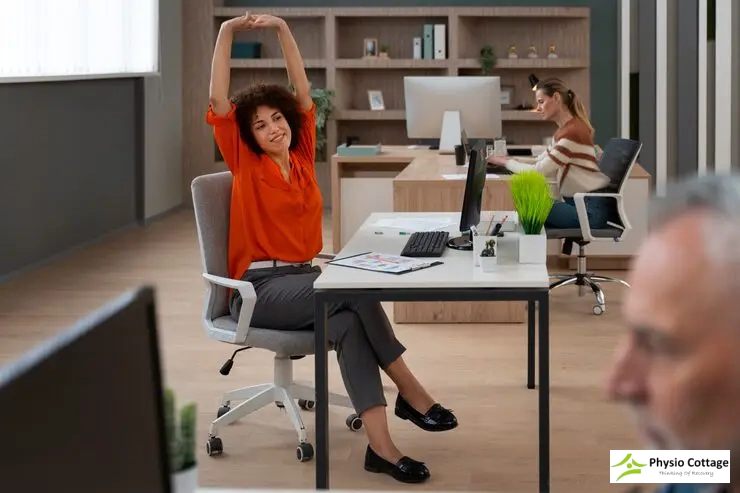
Stand up and reach both arms overhead, clasping your hands. Lean slightly to the right, feeling a stretch along your left side. Hold 15 seconds, switch sides. Then, keeping arms overhead, gently arch backward.
Walking Breaks
This isn’t fancy, but it’s essential. Every hour, walk for at least 2-3 minutes. Take the long route to the bathroom. Walk to a colleague’s desk instead of emailing. Movement breaks matter more than any single exercise.
Desk Push-Ups
Place your hands on your desk, shoulder-width apart. Step your feet back until your body forms a straight line. Lower your chest toward the desk, then push back up. Start with 10 repetitions.
This strengthens the chest, shoulders, and core while getting you out of your chair.
Also Read: Everything You Need to Know About Choosing Physiotherapy in Scarborough
Quick 5-Minute Desk Exercise Routine
Knowing exercises is one thing—doing them consistently is another. Here are three time-efficient routines you can actually stick with.
Morning Energizer Routine
Before diving into work, wake up your body:
- Neck rotations – 30 seconds
- Shoulder rolls – 30 seconds
- Cat-cow stretches – 1 minute
- Standing side stretches – 30 seconds each side
- Calf raises – 1 minute
Total: 4.5 minutes
This activates circulation and prepares your body for the sitting hours ahead.
Midday Reset Routine
Around noon, counteract the morning’s accumulation:
- Upper trapezius stretch – 30 seconds each side
- Doorway chest stretch – 30 seconds each side
- Seated spinal twist – 30 seconds each side
- Wrist circles – 30 seconds
- Figure-four stretch – 30 seconds each side
Total: 5 minutes
Perfect timing: right before or after lunch.
End-of-Day Tension Release Routine
Before leaving work, undo the day’s damage:
- Chin tucks – 1 minute
- Shoulder blade squeezes – 1 minute
- Lower back extension – 30 seconds
- Hip flexor stretch – 30 seconds each side
- Prayer stretch – 30 seconds
Total: 4.5 minutes
You’ll leave the office feeling notably better than if you’d just walked straight out.
Ergonomic Tips to Complement Your Exercises
Exercises help, but fighting against terrible ergonomics all day makes everything harder. Set yourself up for success.
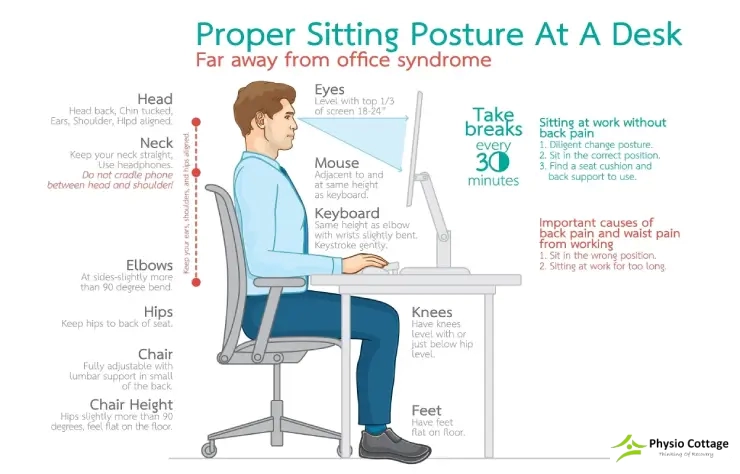
- Proper Desk and Chair Setup: Your chair should allow your feet to rest flat on the floor with knees at 90 degrees.
- Monitor and Keyboard Positioning: Position your monitor at arm’s length away.
- The 20-20-20 Rule for Eye Health: Every 20 minutes, look at something 20 feet away for at least 20 seconds.
Also Read: How Acupuncture near Scarborough, ON, Can Help Relieve Pain Naturally
When to See a Physiotherapist
Self-care works well for prevention and mild discomfort. But some situations call for professional help.
Signs Your Pain Needs Professional Attention
Seek help from a physiotherapist if you experience:
- Pain that persists beyond 2 weeks despite self-care
- Numbness or tingling that doesn’t resolve
- Weakness in your hands, arms, or legs
- Pain that wakes you from sleep
- Symptoms that worsen progressively
- Any sudden, severe pain
For residents of Scarborough, a Scarborough physiotherapy clinic can provide thorough assessment and individualized treatment plans.
FAQs
How often should I do desk exercises?
Aim for brief movement breaks every 30-60 minutes. Even 2-3 minutes of stretching helps. For the full routines outlined above, once or twice daily works well for most people.
Can these exercises really prevent back pain?
Yes—when done consistently. Research confirms that regular stretching and movement breaks significantly reduce the incidence and severity of work-related back pain. Prevention works better than treatment.
What is the best exercise for sitting all day?
If you could only do one thing, stand up and walk briefly every hour. For a single stretch, the seated spinal twist addresses multiple areas—lower back, mid-back, and hips—in one movement.
How long should I hold each stretch?
Hold static stretches for 20-30 seconds to create tissue change. For dynamic movements like shoulder rolls or cat-cow, focus on controlled movement rather than holding time.
When should I see a physiotherapist instead of just doing exercises?
Seek professional help if pain persists beyond two weeks, if you experience numbness or tingling, or if symptoms progressively worsen. A physiotherapist can identify underlying issues that self-care alone won’t resolve.
Build a Healthier Work Routine Today
Your desk job doesn’t have to wreck your body. The exercises in this guide—done consistently—can genuinely transform how you feel at work and beyond.
Start small. Pick three exercises and commit to doing them daily. Once that becomes habit, add more. Movement breaks, even brief ones, compound over time.
Remember: the goal isn’t perfection. It’s progress. Some stretching beats no stretching. Standing up once an hour beats sitting continuously. Every positive choice matters.
If pain already limits your daily activities, or if you want professional guidance to address specific issues, don’t wait until things get worse.
Ready to feel better at your desk job? The team at Physio Cottage specializes in helping office workers in Scarborough overcome pain and build sustainable movement habits.