
How long does it take for tennis elbow to heal with physiotherapy?

Short answer: With physiotherapy, mild tennis elbow often improves in six to eight weeks, moderate cases in three to four months, and long-standing cases can take six months or more. Recovery depends on how long you have had symptoms, how much you load the arm at work and how consistently you do your exercises. Learn about sport injury physiotherapy at Physio Cottage.
Tennis elbow, characterized by inflammation and microtears in the tendons connecting forearm muscles to the elbow, is common, not just athletes but office workers, manual laborers, and anyone performing repetitive arm motions.
Understanding the recovery timeline involves exploring effective tennis elbow exercises, identifying the best anti-inflammatory for tennis elbow, and determining whether a tennis elbow brace supports your healing journey. This thorough guide will reveal exactly how to fix tennis elbow fast and provide evidence-based strategies on how to heal tennis elbow through physiotherapy, helping you return to pain-free movement sooner than you might expect.
If you’re searching for quality physiotherapy, starting treatment at the right time after surgery can significantly impact your recovery outcomes and help you return to daily activities faster.
Tennis Elbow and Its Impact on Daily Life
Tennis elbow, medically termed lateral epicondylitis, represents one of the most common overuse injuries affecting the upper extremity. This condition develops when repetitive gripping, twisting, or lifting motions cause tiny tears in the tendons that attach forearm muscles to the lateral epicondyle, the bony prominence on the outside of your elbow. Despite its name, most people with tennis elbow do not play tennis.
The condition manifests through distinctive symptoms that progressively worsen without intervention. Patients typically experience sharp or burning pain on the outer elbow, weakness in grip strength, and discomfort when lifting objects or shaking hands. These symptoms intensify during activities requiring wrist extension or forearm rotation, significantly impacting professional productivity and quality of life.
At the cellular level, tennis elbow represents a degenerative condition rather than purely inflammatory. This condition often persists despite rest alone.
Realistic Timeline: How Long Does Tennis Elbow Take to Heal?
How long does tennis elbow take to heal depends on several critical factors, including injury severity, treatment adherence, and individual healing capacity. For mild tennis elbow recovery, patients typically experience significant improvement within 6-8 weeks of consistent physiotherapy. Moderate cases generally require 3-4 months, while severe or chronic conditions may need 6-12 months of dedicated treatment.
Most people improve with conservative physiotherapy care. However, the timeline varies considerably based on when treatment begins. Starting care early often makes recovery easier than waiting months.
Factors Influencing Your Personal Recovery Timeline
Multiple variables affect individual healing trajectories. Age plays a role, as tissue regeneration naturally slows after 40. Occupational demands matter significantly, manual laborers face longer recovery periods due to continued stress on healing tissues. Doing your home exercises consistently matters a great deal.
Pre-existing health conditions also impact healing speed. Diabetes, smoking, and poor circulation impair tissue repair mechanisms, which can lengthen recovery. Conversely, optimal nutrition, adequate sleep, and stress management accelerate healing. The severity and duration of symptoms before treatment initiation represent perhaps the most significant predictors, acute cases caught early tend to respond well, while chronic conditions require patience and persistence.
Evidence-Based Strategies
The cornerstone of rapid recovery involves early mobilization through controlled loading. Complete rest is rarely the answer, because appropriate movement stimulates healing. The key lies in finding the therapeutic window, challenging tissues enough to promote adaptation without causing further damage. Physiotherapists adjust exercise intensity, gradually progressing from isometric holds to eccentric strengthening as tissues adapt.
The Role of Manual Therapy in Accelerating Recovery
Skilled manual therapy techniques significantly enhance treatment outcomes. Deep friction massage breaks down scar tissue and promotes proper collagen alignment. Joint mobilizations restore optimal elbow mechanics, reducing compensatory stress patterns. Soft tissue release addresses muscular restrictions in the forearm, shoulder, and cervical spine that often contribute to persistent symptoms.
Instrument-assisted soft tissue mobilization (IASTM) has emerged as a powerful adjunct therapy. This technique uses specialized tools to detect and treat fascial restrictions, improving tissue quality and extensibility. Some people find that combining IASTM with exercise helps ease pain. Similarly, dry needling of trigger points in affected muscles provides rapid pain relief while enhancing motor control.
Our whole-person physiotherapy considers not just your surgical site, but your overall physical and emotional well-being throughout the post-operative recovery process.
Essential Tennis Elbow Exercises for Complete Recovery
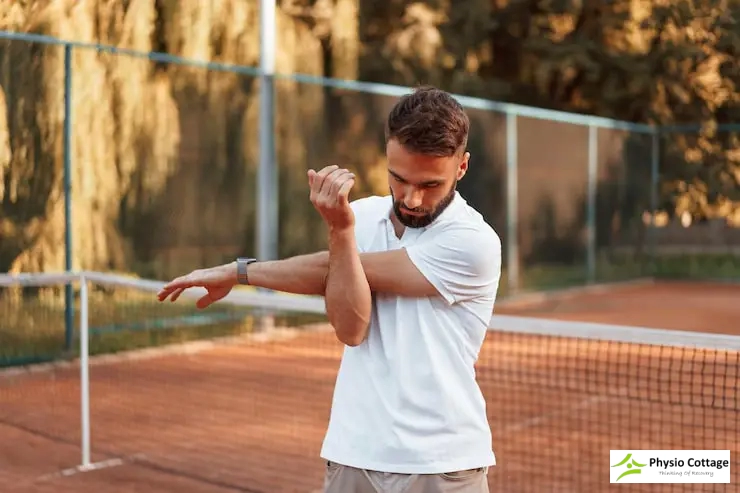
Tennis elbow exercises form the foundation of successful physiotherapy treatment. A critical component of treatment is selecting the best anti-inflammatory for tennis elbow to manage pain while consistently performing rehabilitative movements, ensuring a faster recovery time. Progressive exercise protocols target three key objectives: restoring pain-free range of motion, rebuilding tendon strength, and retraining functional movement patterns.
Phase One: Initial Pain Management and Mobility
The first exercise phase focuses on gentle mobility and pain-free activation. Wrist extensions with minimal resistance begin with the forearm supported, palm facing down, slowly lifting the hand upward against gravity. Perform 3 sets of 15 repetitions, three times daily. Forearm pronation-supination involves rotating the palm up and down with the elbow bent at 90 degrees, promoting blood flow without excessive stress.
Gentle ball squeezes maintain grip strength while respecting pain limits. Using a soft therapy ball or rolled towel, apply comfortable pressure for 5-second holds, repeating 10-15 times. Wrist flexor stretches provide balance to extensor loading, with the arm extended and palm up, gently pull fingers downward with the opposite hand, holding 30 seconds. These foundational movements prepare tissues for progressive strengthening.
Phase Two: Eccentric Strengthening Protocol
Eccentric exercises, where muscles lengthen under tension, are a common part of tendinopathy rehab. The Tyler Twist exercise specifically targets tennis elbow and is widely used. Hold a rubber bar or rolled towel vertically, twist it with both hands (affected hand twisting into wrist flexion), extend the elbow while maintaining the twist, then slowly untwist with the affected hand.
Eccentric wrist extension involves using the unaffected hand to lift a light dumbbell (1-3 pounds) into wrist extension, then slowly lowering with the affected hand over 5 seconds. Perform 3 sets of 15 repetitions daily. As strength improves, gradually increase weight by half-pound increments weekly. Finger extensor strengthening using resistance bands addresses often-overlooked weakness, place a rubber band around all five fingertips and spread fingers against resistance, holding 5 seconds.
Phase Three: Functional Integration and Return to Activity
Advanced exercises simulate real-world demands, ensuring safe activity resumption. Wrist stability drills involve maintaining neutral wrist position while performing various arm movements, circles, reaches, and lifting patterns. Progressive gripping activities begin with light objects, gradually advancing to work-specific or sport-specific implements. The key principle involves monitoring next-day soreness; acceptable discomfort should resolve within 24 hours.
Proprioceptive training reestablishes neuromuscular control through exercises like ball tosses against a rebounder or stability ball push-ups. These movements challenge coordination and reaction time, preparing tissues for unpredictable loads encountered in daily activities. Plyometric exercises, starting with gentle wrist bounces and progressing to medicine ball catches, represent the final stage before full activity clearance.
Choosing the Best Anti-Inflammatory for Tennis Elbow
Selecting the best anti-inflammatory for tennis elbow requires understanding both pharmaceutical and natural options. Non-steroidal anti-inflammatory drugs (NSAIDs) like ibuprofen or naproxen provide short-term pain relief, particularly during acute flare-ups. However, prolonged NSAID use may actually impair tendon healing by suppressing necessary inflammatory signals that initiate tissue repair.
For optimal results, limit NSAID use to the first 7-10 days when inflammation is most pronounced, taking medications with food to minimize gastric irritation. A typical dosage involves ibuprofen 400mg three times daily or naproxen 500mg twice daily, always following package instructions and consulting healthcare providers about individual appropriateness. Beyond this window, focusing on tissue loading through exercise proves more effective than continued medication use.
Tennis Elbow Brace: When and How to Use One Effectively
A tennis elbow brace, also called a counterforce brace, can play a strategic role in recovery when used appropriately. These devices work by redistributing forces away from the damaged tendon insertion, essentially “unloading” the lateral epicondyle. A brace can ease pain during activities, allowing patients to maintain function while tissues heal.
The optimal brace fits snugly around the upper forearm, approximately 2-3 finger widths below the elbow crease. The pressure pad should align directly over the muscle belly of the forearm extensors. Proper tension is crucial, too loose provides no benefit, while too tight impairs circulation. The brace should feel supportively snug without causing numbness, tingling, or discoloration.
Strategic Brace Implementation for Maximum Benefit
Contrary to common practice, wearing a tennis elbow brace continuously is counterproductive. Constant bracing causes muscle deconditioning and dependency, ultimately prolonging recovery. Instead, use the brace strategically during aggravating activities, typing, lifting, gripping tools, then remove it during rest periods. This approach protects healing tissues during stress while allowing natural muscle activation during daily movements.
Thorough Treatment: How to Heal Tennis Elbow Completely
Effective strategies on “how to heal tennis elbow” will not only reduce the recovery time but also guide you through the correct tennis elbow exercises and help evaluate if a specialized tennis elbow brace is necessary for your case. Complete healing requires addressing contributing factors beyond the elbow itself, including posture, biomechanics, and ergonomic modifications.
Physiotherapists assess the entire kinetic chain, from cervical spine to fingertips, identifying dysfunction that overloads elbow structures. Shoulder weakness commonly contributes to tennis elbow, as compensatory patterns place excessive demand on forearm muscles. Core instability similarly causes distal overload. Thorough treatment programs address these proximal deficits through targeted strengthening, typically involving rotator cuff exercises, scapular stabilization drills, and thoracic mobility work.
Does Tennis Elbow Ever Go Away? Long-Term Outlook and Prevention
With appropriate treatment, most people recover fully. However, this requires commitment to the full rehabilitation protocol, not just symptomatic relief.
A small number of people still have symptoms after 12 months of conservative care. These patients may benefit from advanced interventions like platelet-rich plasma (PRP) injections, which use concentrated growth factors from your own blood to stimulate tissue regeneration. Shockwave therapy, using acoustic waves to promote healing, is another option some people try. Surgery remains a last resort, reserved for cases failing 6-12 months of thorough conservative care.
Prevention Strategies for Long-Term Success
Preventing recurrence requires ongoing attention to risk factors. Maintain a regular exercise routine emphasizing forearm and grip strength, performing your rehabilitation exercises 2-3 times weekly indefinitely can help keep symptoms from returning. Address any new activities gradually; when starting tennis, golf, gardening, or manual labor, progress intensity and duration slowly, allowing tissues to adapt.
Recognize early warning signs of overload. Mild achiness after activity is acceptable, but sharp pain during movements or persistent next-day soreness signals excessive demand. Scale back activity immediately at the first sign of symptom recurrence, implementing a brief period of modified activity and exercise focus. This proactive approach prevents minor setbacks from becoming major relapses. Annual reassessment with a physiotherapist provides objective monitoring and allows for program adjustments as life demands change.
Also Read: How Do i Know if i Need Physiotherapy?
The Physiocottage Approach to Tennis Elbow Treatment
We recognize that each patient presents unique circumstances, different occupational demands, activity goals, and healing capacities. Our thorough initial assessment identifies not just the elbow pathology but all contributing factors throughout your movement system.
Treatment plans combine several approaches. Manual therapy addresses tissue quality and joint mechanics. Progressive exercise protocols are carefully calibrated to your current capacity and systematically advanced. Education empowers you with understanding of your condition, promoting active participation in recovery. We emphasize home exercise adherence through clear instruction, written programs, and video demonstrations accessible through our patient portal.
Our physiotherapists keep their tennis elbow care current. We utilize outcome measurement tools to objectively track your progress, adjusting treatment approaches based on response. Beyond symptom resolution, we focus on injury prevention and performance optimization, ensuring you not only recover but improve beyond your pre-injury baseline. This thorough approach explains our consistently excellent outcomes and patient satisfaction ratings.
Our team of registered physiotherapists can build a tennis elbow plan around your work and activities.
Frequently Asked Questions
How long will tennis elbow take to heal with physiotherapy?
Mild: 6 to 8 weeks. Moderate: 3 to 4 months. Severe/chronic: 6 to 12 months. Consistent physio + home exercises often shorten recovery.
Can tennis elbow heal in 4 weeks?
Rarely. Only very mild cases with perfect compliance and early intervention. Most people still need 6+ weeks.
Why is my tennis elbow not improving after 2 months?
Common reasons: still overloading the tendon, poor exercise technique, no eccentric loading, skipped manual therapy, or it’s actually something else (radial tunnel, cervical referral).
Is heat or ice better for tennis elbow?
First 7 to 10 days → ice. After that → heat or contrast therapy to promote blood flow and healing.
Should I wear a tennis elbow brace all day?
No. Only during aggravating activities. Wear it 4 to 6 hours max per day, 4 to 6 weeks, then gradually wean off as strength improves.
Will tennis elbow go away on its own without treatment?
Some people improve with rest alone over 6 to 12 months, but pain may return because the tendon hasn’t been properly remodelled. Physio gives 90+% full recovery and prevents recurrence.
Can I still lift weights with tennis elbow?
Yes, but only pain-free exercises. Avoid gripping/loading through pain >3/10. Switch to eccentric-only protocol and use straps, fat grips, and blood flow restriction if needed.
Is dry needling or shockwave better for stubborn cases?
Both work well. Dry needling + manual therapy usually gives faster pain relief (2 to 4 sessions). Shockwave is excellent for chronic cases that failed everything else.
When can I return to tennis/sport?
When you have full pain-free strength grip = opposite side) and can do sport-specific drills without pain or weakness. Usually 4 to 6 months for competitive play.
Your Path to Recovery Starts Now
If you are experiencing tennis elbow symptoms, don’t wait for the condition to worsen. Contact Physio cottage today to schedule a thorough assessment with our specialized physiotherapists. We will develop a personalized treatment plan targeting your specific needs, combining hands-on therapy, progressive exercises, and patient education to accelerate your recovery.
Related guides
- How long does a massage take?
- How Long Does It Take for Physiotherapy to Show Results?
- How Do I Get My Sciatic Nerve to Stop Hurting?
Book your physiotherapy assessment
Physio Cottage, 2231 Victoria Park Ave, Unit #5, Scarborough, ON M1R 1V8. Open Monday to Friday 10am to 8pm and Saturday 9am to 5pm. Direct billing where your plan allows.
- One-to-one assessment with a registered practitioner
- Evening and Saturday appointments
- Parking at Victoria Park and Ellesmere

About the author and clinical reviewer
Maryam Ahankoob, Registered Physiotherapist at Physio Cottage, 2231 Victoria Park Ave, Unit #5, Scarborough, ON M1R 1V8. Questions about this article or your own symptoms? Call (416) 445-5353 or learn more about our clinic.
This article is general information, not a diagnosis. Please book an assessment for advice about your situation.