
You’re in the middle of a workout, a run through the park, or maybe just lifting a heavy box in the garage, and suddenly—snap. A sharp, stinging pain shoots through your muscle. You know immediately that you’ve pushed it too far.
The first question that hits everyone’s mind isn’t usually “what is the cellular biology of this injury?” It’s almost always: “How long until I can move normally again?”
The answer is rarely a single number. While your friend might have bounced back from a hamstring pull in two weeks, your recovery could look entirely different. Recovery isn’t just about waiting; it’s about active management. At Physio Cottage, we see everything from minor tweaks to major tears, and the timeline relies heavily on the “grade” of your injury and how quickly you start physiotherapy scarborough.
This guide cuts through the noise to give you a realistic, honest look at muscle strain recovery times and how professional care bridges the gap between being injured and being unstoppable.
Muscle Strains Explained: What’s Happening Beneath the Surface?
To predict how long you’ll be on the sidelines, we need to clarify what actually happened to your body. A muscle strain—often called a “pulled muscle”—occurs when muscle fibers or tendons are stretched beyond their limits or forced to contract too strongly. Think of your muscle like a rope. If you pull it slightly too hard, a few threads might fray. Yank it violently, and the whole rope could snap.
Unlike a simple bruise, a strain involves structural damage to the tissue that requires a biological healing process. It’s not just about pain fading away; it’s about knitting those fibers back together so they can handle a load again without failing.
The Difference Between a Sprain and a Strain
People often use these terms interchangeably, but in the medical world, they are distinct. A sprain involves ligaments—the tough bands connecting bone to bone. If you roll your ankle, that’s usually a sprain.
A strain, on the other hand, affects muscles or tendons (the cords attaching muscle to bone). Whether it’s your lower back, hamstring, or calf, the recovery approach we use at our scarborough physiotherapy clinic is specifically designed to target soft tissue regeneration, which differs significantly from ligament repair.
Common Signs You Need Physiotherapy
You might be tempted to just “walk it off,” but ignoring certain signals can turn a short-term issue into a chronic nightmare. If you experience the following, professional intervention is crucial:
- Audible Pop or Snap: Hearing a noise at the moment of injury often indicates a higher-grade tear.
- Significant Swelling or Bruising: This suggests internal bleeding within the muscle tissue.
- Inability to Bear Weight: If you can’t use the limb, the structural integrity is compromised.
- Pain at Rest: If it hurts even when you aren’t moving, the inflammation is severe.

Muscle Strain Recovery Timeline by Grade (The Grading System)
The “how long” question is best answered by the grading system. Physiotherapists categorize strains into three levels of severity. This isn’t just for paperwork; it dictates your entire rehab roadmap. Without a proper assessment, you might be treating a Grade 2 injury like a Grade 1, which is a recipe for re-injury.
Grade 1 (Mild Strain): 2–4 Weeks
This is the “nuisance” injury. You’ve overstretched the muscle, and less than 5% of the fibers are damaged.
- What it feels like: You’ll feel tightness and mild tenderness. You can still move the limb, and strength is mostly normal, but it hurts to stretch.
- The Timeline: With proper rest and gentle movement, these often heal within 2 to 4 weeks. However, ignoring the tightness can easily escalate this into a Grade 2.
- Physio Role: We focus on active release and preventing stiffness so you don’t develop bad movement patterns.
Grade 2 (Moderate Strain): 4–8 Weeks
This is the “stopper.” A significant number of muscle fibers are torn, but the muscle is not completely ruptured.
- What it feels like: The pain is more immediate and sharper. You might see swelling or minor bruising. Using the muscle is painful, and there is a noticeable loss of strength.
- The Timeline: Expect a recovery window of 4 to 8 weeks. The first week is often about pain control, while weeks 4 through 8 are about rebuilding load capacity.
- Physio Role: This requires structured rehab. Services like acupuncture scarborough can be incredibly effective here to manage the acute pain without relying solely on medication.
Grade 3 (Severe Strain/Tear): 3 Months or Longer
This is a serious medical event. It involves a complete rupture of the muscle or tendon.
- What it feels like: Intense pain, massive swelling, and often a visible “bunching” of the muscle under the skin because it has snapped back like a cut rubber band. You likely have zero function in that muscle.
- The Timeline: 3 months is the minimum, but full return to sport can take 6 months or more. In some cases, surgery is required before rehab can even begin.
- Physio Role: Post-surgical or conservative management of a Grade 3 tear requires strict supervision by registered physiotherapists scarborough to ensure the scar tissue forms correctly and the muscle regains its ability to fire.
Also Read: What Are the Benefits of Deep Tissue Massage for Muscle Recovery?
The 3 Phases of Tissue Healing in Physiotherapy
One of the biggest misconceptions is that healing is linear. In reality, your body goes through three distinct biological phases. Physiotherapy doesn’t speed up biology, but it creates the perfect environment for each phase to happen efficiently, preventing the process from stalling.
Phase 1: Inflammatory Phase (Protection & Pain Management)
Duration: Day 1 to Day 7
Immediately after the injury, your body sends a rush of blood and cells to the area to “clean up” the damage. This causes swelling and heat. While uncomfortable, this inflammation is necessary.
Our goal here isn’t to stop inflammation completely but to control it so it doesn’t cause secondary damage. We focus on protection (taping, bracing), gentle motion to flush out fluids, and pain relief modalities.
Phase 2: Reparative Phase (Regaining Mobility)
Duration: Week 2 to Week 6
This is the danger zone. Your body lays down new collagen (Type III) to patch the tear. This new tissue is like a messy spiderweb—it holds things together but is weak and disorganized.
Because pain often decreases significantly in this phase, many patients think they are healed. They return to heavy lifting and tear the fragile new tissue. Physio here involves guiding the new fibers to align correctly through specific movements, sometimes integrating holistic physiotherapy scarborough approaches to treat the whole kinetic chain, not just the injury site.
Phase 3: Remodeling Phase (Strengthening & Return to Sport)
Duration: Week 6 to Months
Now, the body converts the temporary collagen into stronger, permanent tissue (Type I). This is where the real work happens. We increase the load, add plyometrics, and focus on sport-specific drills.
If you skip this phase, you are left with a “healed” muscle that is structurally weak, leading to the cycle of chronic pain where the injury flares up every few months.

Key Factors That Influence Your Recovery Speed
You might wonder why your teammate recovered in three weeks while you are still limping at week five. Muscle recovery is bio-individual. Several variables dictate how fast your body can repair itself, and recognizing these helps us tailor your treatment plan at Physio Cottage.
- Age and General Health: As we age, our metabolic rate slows down, and collagen production decreases. A 20-year-old athlete will naturally heal faster than a 50-year-old weekend warrior. Pre-existing conditions like diabetes can also slow tissue repair.
- Severity and Location of the Injury: Muscles with high blood supply (like the facial muscles) heal fast. Muscles and tendons with poor blood supply (like the rotator cuff or Achilles) take much longer. Lower body injuries often take longer simply because we have to walk on them.
- Consistency with Home Exercises (Compliance): This is the game-changer. Patients who do their prescribed exercises daily see results weeks ahead of those who only work out during their clinic appointments.
- Nutrition and Hydration: Your body needs building blocks to repair tissue. Protein, Vitamin C, and hydration are fuel for recovery. Dehydration can make fascia sticky and brittle, slowing down the process. For those dealing with lingering issues due to poor initial management, looking into chronic pain treatment scarborough can help reset the recovery clock.
Also Read: Sports Injury Physiotherapy in Scarborough — Get Back to Your Best Shape
How Physiotherapy Accelerates the Healing Process
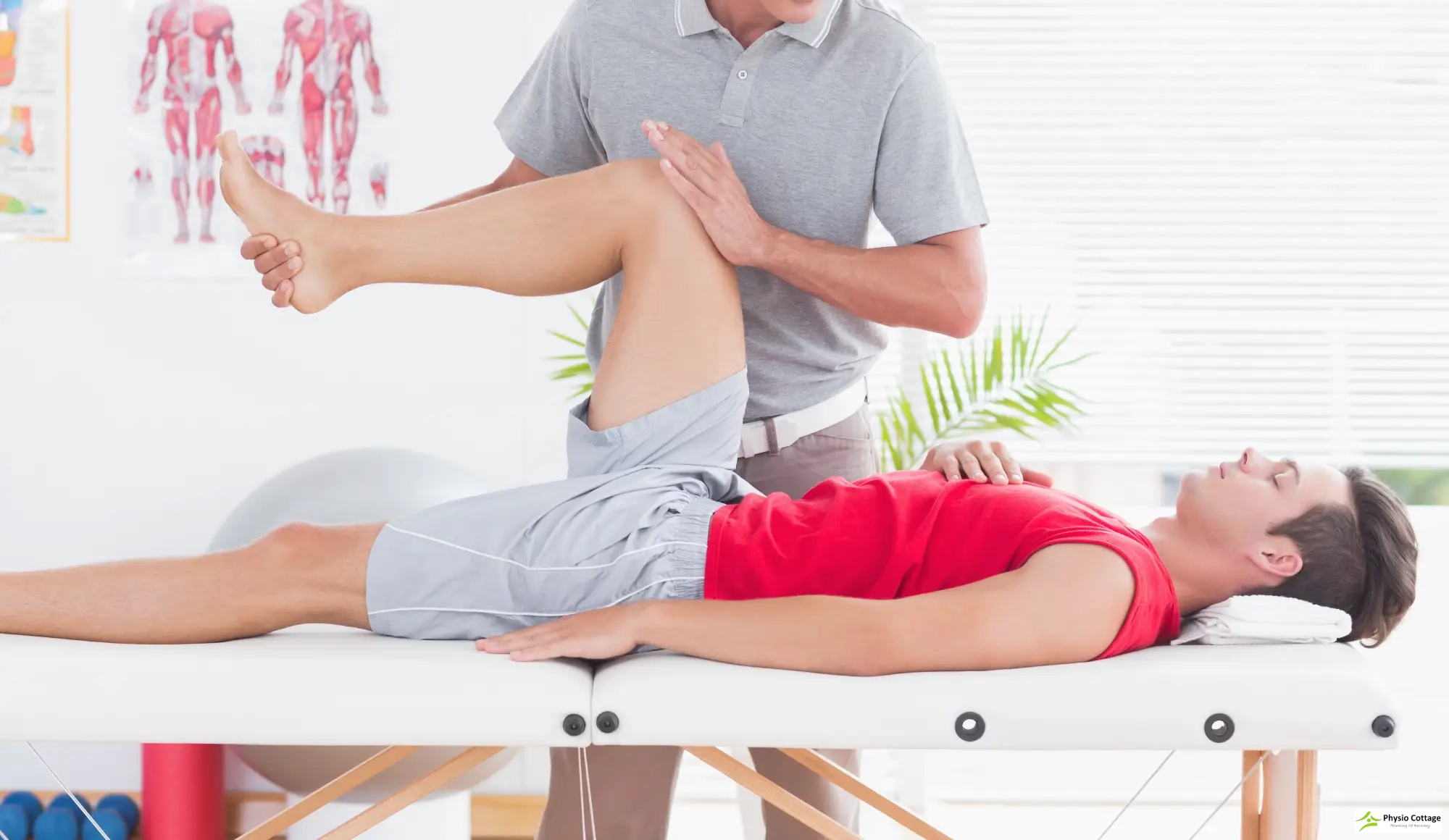
Waiting for a muscle to heal on its own is like hoping a broken car fixes itself in the garage. It might eventually run, but it won’t run well. Physiotherapy actively intervenes to guide the healing process, ensuring the muscle heals strong, not just closed.
Manual Therapy to Improve Blood Flow
Hands-on treatment is vital. Techniques aimed at mobilizing soft tissue help break up adhesions and flush out stagnant fluid. For many patients, integrating massage therapy scarborough alongside physio helps keep the surrounding muscles loose, preventing the “guarding” effect where nearby muscles tighten up to protect the injury.
Modalities (Ultrasound, Laser, Shockwave) for Inflammation
We use technology to jumpstart cellular activity. Therapeutic ultrasound or laser can increase energy production (ATP) in the cells, speeding up the transition from the inflammatory phase to the repair phase. This is particularly useful for stubborn strains that feel stuck.
Targeted Exercise Therapy to Prevent Scar Tissue
When a muscle heals naturally, it forms scar tissue. Scar tissue is stiff and doesn’t stretch. Through specific eccentric exercises (lengthening the muscle under tension), we can encourage the muscle fibers to heal in parallel lines rather than a clump. Sometimes, techniques like myofascial release scarborough are used to free up the fascia surrounding the muscle, allowing for smooth gliding of the fibers.
Also Read: Neck Pain Relief in Scarborough — How Physiotherapy Helps You Heal Faster
When Will I Start Seeing Results?
It is natural to want a specific date on the calendar, but healing is biological, not mathematical. However, you should see trends in your recovery that indicate you are on the right path.
Pain Relief vs. Full Functional Recovery
You will likely feel “better” long before you are “healed.” Pain relief often occurs within the first 1-2 weeks of treatment. This is the reduction of chemical inflammation. However, functional recovery—the ability to sprint, jump, or lift—takes much longer. We have to train you to distinguish between “hurt” (damage) and “sore” (work).
Recognizing Milestones in Your Rehab Journey
Instead of watching the clock, watch for milestones:
- Restored Range of Motion: Can you stretch the muscle as far as the uninjured side?
- Symmetrical Strength: Is the injured muscle producing at least 90% of the force of the healthy side?
- Pain-Free Functional Movement: Can you perform a squat, lunge, or throw without flinching?
Sometimes, alignment issues in the spine or pelvis contribute to muscle strain. In these cases, we might coordinate with Chiropractic Care Scarborough to ensure your skeletal structure supports your muscular recovery.

The Risks of Returning to Activity Too Early (Re-injury)
The most dangerous words in rehabilitation are: “I feel fine.”
When pain vanishes, the tissue is often at only 50-60% of its tensile strength. Returning to full-contact sports or heavy labor at this stage is the leading cause of recurrent muscle strains.
Why “No Pain” Doesn’t Mean “Fully Healed”
Pain is a warning system, but it turns off before the repair work is done. If you return to play during the Reparative Phase, you risk tearing the immature collagen. This second injury is almost always worse than the first because you are now tearing through scar tissue, which has less blood supply than healthy muscle.
The Importance of Completing the Full Course of Care
Rehab isn’t done when you can walk; it’s done when you can perform. We often see patients who drop out of care at week 3, only to return at month 3 with a chronic, nagging issue. For newcomers to Canada or those navigating the healthcare system, our refugee physiotherapy scarborough services ensure that everyone has access to this vital educational component of recovery.
FAQ
How many physio sessions will I need per week?
Typically, we start with 2 sessions per week during the acute phase to manage pain and monitor early movement. As you progress to the strengthening phase, this often drops to once a week or once every two weeks, shifting the focus to your home gym program.
Can physiotherapy heal an old (chronic) muscle strain?
Yes. An old injury often hurts because of scar tissue and poor movement patterns. We can remodel that tissue and retrain your brain to trust the muscle again, though it may take longer than an acute injury.
Is heat or ice better for a muscle strain?
Generally, ice is used in the first 48-72 hours to control excessive swelling. After that, heat is preferred to bring blood flow to the area and relax tight tissues.
Will I need an MRI for my muscle strain?
Most strains are diagnosed clinically by a physiotherapist. We only recommend imaging if we suspect a Grade 3 full rupture or if the injury isn’t responding to treatment as expected.
Does physio hurt?
Some techniques, like deep tissue work or breaking down scar tissue, can be uncomfortable (“good pain”). However, we always work within your tolerance. The goal is to stimulate healing, not create more trauma.
The Key to a Faster Recovery
Recovering from a muscle strain is a journey of patience and precision. While a Grade 1 strain might just be a speed bump of a few weeks, a Grade 3 tear is a major detour. The deciding factor in how well and how fast you heal is often the quality of guidance you receive.
At Physio Cottage, we don’t just treat the pain; we treat the person. Whether you need manual therapy, acupuncture, or a robust strength conditioning plan, our team in Scarborough is ready to get you back to the life you love—stronger than before.
Don’t let a temporary strain become a permanent weakness.
Ready to start your recovery?
Book an appointment with Physio Cottage today and let’s get you moving again.

About the author and clinical reviewer
Dr. Maryam Ahankoob, Registered Physiotherapist at Physio Cottage, 2231 Victoria Park Ave, Unit #5, Scarborough, ON M1R 1V8. Questions about this article or your own symptoms? Call (416) 445-5353 or learn more about our clinic.
This article is general information, not a diagnosis. Please book an assessment for advice about your situation.