
Here’s something we hear almost every week at our clinic: “My knee feels fine now, so I think I’m good to stop coming.” And honestly? That statement makes perfect sense on the surface. Pain brought you in. Pain is gone. Why keep showing up?
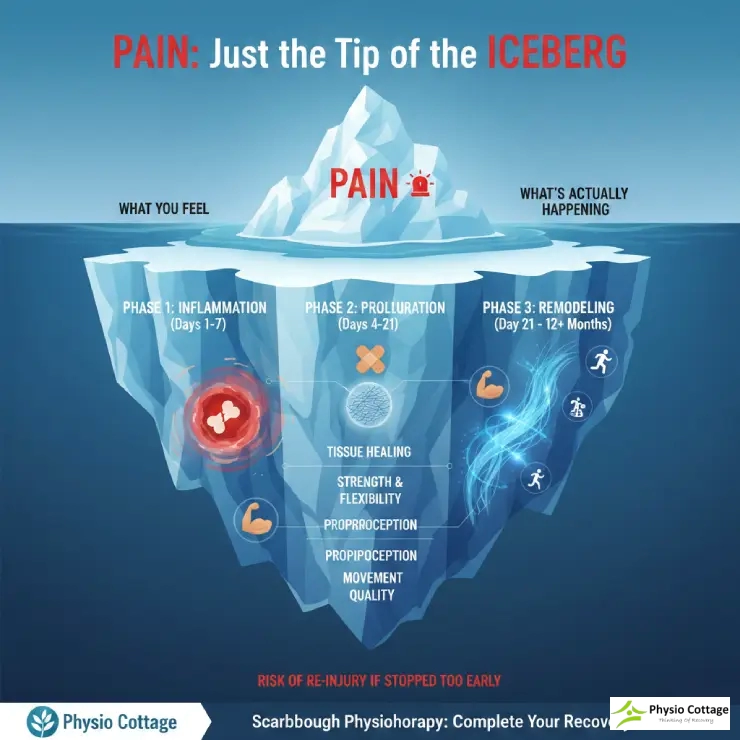
But here’s the catch, and it’s a big one. Pain is just the tip of the iceberg when it comes to musculoskeletal health. What lies beneath the surface often tells a completely different story.
At Physio Cottage, we’ve watched countless patients walk away too soon, only to return weeks or months later with the same issue, sometimes worse. This pattern isn’t about keeping you on the treatment table longer than necessary. It’s about what actually happens inside your body during recovery.
The truth is, your tissues heal on their own timeline, and that timeline rarely matches when your pain decides to quiet down.
Pain as a Messenger, Not a Measuring Stick
Think of pain like a smoke alarm. When it goes off, something’s wrong. When it stops, does that mean there’s no damage? Not necessarily. The fire might be contained, but the structural damage could still need serious attention.
Your nervous system is remarkably good at adaptation. After the initial injury phase, it often dials down pain signals even while your tendons, ligaments, or muscles are still in the middle of repair. This is your body’s way of letting you function, but it’s not a green light to return to full activity.
Research published in the Journal of Orthopaedic & Sports Physical Therapy shows that tissue remodeling can take anywhere from 3 to 12 months, depending on the injury type. Pain typically subsides much earlier in this window.

The Science Behind Tissue Healing Phases
Your body goes through distinct phases when recovering from injury, and each phase requires different things from you.
Inflammatory Phase: Days 1-7
This is when pain is usually at its peak. Swelling, redness, heat, your body is sending repair crews to the site. Most people seek help during this stage, which makes sense.
Proliferation Phase: Days 4-21
New tissue starts forming. Collagen fibers begin laying down, but they’re disorganized and weak. Pain often starts decreasing here, which tricks people into thinking they’re healed. They’re not. Not even close.
Remodeling Phase: Day 21 to 12+ Months
This is where the magic happens, or doesn’t. Those collagen fibers need to be stressed appropriately to align properly and regain strength. Without continued physiotherapy in Scarborough, this phase often gets neglected.
Skip this phase, and you end up with scar tissue that’s weaker, less flexible, and more prone to re-injury.
What Actually Happens When You Quit Too Early
Let’s walk through a typical scenario we see at our Scarborough physiotherapy clinic.
The Initial Injury
Sarah comes in with a rotator cuff strain. She’s been having trouble lifting her arm and sleeping on that side is impossible. Classic presentation.
The Treatment Phase
After four weeks of targeted exercises, manual therapy, and some acupuncture in Scarborough, Sarah’s pain drops from a 7 to a 2. She can sleep again. She can reach the top shelf. Life feels normal.
The Premature Exit
Sarah decides she’s good. Why keep coming? Her shoulder feels fine.
Three Months Later
Sarah returns. Same shoulder, new problem. Now there’s clicking, some weakness when carrying groceries, and her range of motion isn’t quite right. What happened?
Her shoulder never completed the remodeling phase. The rotator cuff tendons didn’t regain full tensile strength. The stabilizing muscles that were supposed to be retrained? Still weak. Her movement patterns? Still compensatory.
She essentially built a house on a shaky foundation, and now it’s showing cracks.
Also Read: Physiotherapy for Knee Pain: Causes and Treatment Options
The Real Markers of Complete Recovery
If pain isn’t the right finish line, what is? This is where things get practical.
Full Range of Motion
Can you move the affected area through its complete, normal range? Not just “good enough” range, full range. Compare it to your uninjured side if applicable.
Strength Symmetry
For limb injuries, your strength should be within 90% of the opposite side. This requires actual testing, not just feeling strong.
Functional Performance
Can you do everything you need to do in daily life AND in your recreational activities? This includes sport-specific movements, occupational demands, and unexpected challenges like catching yourself from a fall.
Proprioception and Balance
Your body’s awareness of where it is in space often takes a hit after injury. This needs specific rehabilitation to restore.
Movement Quality
Are you moving correctly, or have you developed compensations that might lead to problems elsewhere? Our registered physiotherapists in Scarborough assess this carefully before clearing anyone.
The Psychology of Pain and Recovery
There’s another layer here that doesn’t get talked about enough.
The Fear-Avoidance Cycle
When something hurts, you avoid it. Makes sense. But sometimes, even after pain resolves, that avoidance pattern sticks around. You might not even notice you’re doing it.
Maybe you stopped rotating your trunk fully during that low back episode. Pain’s gone now, but you’re still moving like it might come back any second. This altered movement pattern becomes your new normal, and it’s often a setup for future problems.
Confidence in Movement
Part of what we do at Physio Cottage involves rebuilding your confidence in your body. When you’ve been hurt, there’s a psychological component to recovery that’s just as important as the physical one.
Stopping treatment when pain stops means you miss this piece entirely.
The Financial Argument That Actually Makes Sense
“But physiotherapy costs money,” people say. Fair point. Let’s run the numbers though.
Scenario A: Stop When Pain Stops
- 6 sessions before pain resolves
- Feel fine for 4 months
- Re-injury occurs
- 10 more sessions needed
- Possible time off work
- Potential imaging costs
- Total: More money, more time, more frustration
Scenario B: Complete the Full Treatment Plan
- 10-12 sessions total
- Full tissue healing achieved
- Prevention strategies in place
- Return to all activities with confidence
- Total: Initial investment pays off in avoided future costs
We’re not suggesting everyone needs endless treatment. That’s not the point. The point is that arbitrary stopping points based on pain alone usually cost more in the long run.
When IS It Actually Time to Stop?
Good question. Here’s what we look at before discharging anyone from our holistic physiotherapy in Scarborough program:
Objective Criteria Met
All the markers mentioned earlier, range of motion, strength, function, balance, movement quality, should be where they need to be.
Goals Achieved
Remember those goals we set at the beginning? Running a 5K again, picking up your grandkids, returning to hockey without fear? Those should be checked off.
Home Program Independence
You should know exactly what to do on your own to maintain your progress. This isn’t about creating dependency, it’s about building self-sufficiency.
Prevention Education Complete
You understand what led to your injury and how to reduce the risk of it happening again.
Gradual Transition
Often, we’ll space out appointments as you approach discharge. Weekly becomes biweekly becomes monthly check-ins. This lets us catch any issues before they become problems.
Also Read: Physiotherapy for Shoulder Pain: Causes, Treatment, Recovery
Special Populations and Considerations
Different people need different approaches to treatment completion.
Athletes
Sport-specific rehabilitation takes longer than basic pain resolution. Returning to competition requires passing sport-specific tests, not just feeling okay during daily activities.
Post-Surgical Patients
Surgical protocols exist for a reason. Your surgeon and physiotherapist have coordinated a timeline based on how tissues heal after specific procedures. Pain resolution doesn’t override these protocols.
Older Adults
Age-related changes in tissue healing mean longer timelines are often necessary. Additionally, maintaining the gains becomes increasingly important as we age.
Workers with Physical Jobs
Returning to heavy lifting, repetitive movements, or prolonged positions requires conditioning beyond basic pain resolution.
Building a Partnership with Your Physiotherapist
The best outcomes happen when you and your therapist are on the same page about treatment progression.
Ask Questions
Don’t know why you’re still coming? Ask. A good physiotherapist will explain exactly what still needs work and why.
Share Your Concerns
If cost or time is becoming an issue, say so. We can often adjust treatment frequency or focus on home exercises while maintaining progress.
Trust the Process
This might sound cliché, but there’s something to it. Your therapist has seen hundreds of cases like yours. They know what premature discharge looks like and what complete recovery looks like.
Stay Engaged
The exercises you do at home matter more than the time you spend in the clinic. Staying compliant with your home program accelerates everything.
Prevention Over Repeat Treatment
Here’s what we really want for you: to not need us.
Seriously. The goal isn’t to keep you coming back forever. The goal is to get you so well-recovered and so well-educated that you can maintain your health independently.
But here’s the thing, that goal is only achievable if you complete treatment properly the first time. Cut it short, and you’ll likely be back. Finish it properly, and you might not see us again for years.
At Physio Cottage, our registered physiotherapists in Scarborough take pride in proper discharge planning. We want to see you succeed, not just feel better temporarily.

The Bottom Line
Pain stopping is a milestone, not a finish line. It means your body has moved through one phase of healing, but other phases remain. The discomfort that brought you in for help was just one symptom of a larger picture that includes tissue integrity, movement quality, strength, coordination, and confidence.
Walking away when pain subsides is like leaving a construction site when the framing is up but the roof isn’t on yet. Everything looks fine until the first rainstorm.
Give your body the full support it needs. Complete your treatment plan. Ask your physiotherapist what “done” actually looks like for your specific situation.
Your future self, the one who wants to stay active, avoid re-injury, and live without limitations, will thank you.
FAQ
How long should physiotherapy continue after pain stops?
This varies by injury type, but expect 4-8 additional weeks for most soft tissue injuries. Your physiotherapist will use objective measures, not just how you feel, to determine when treatment is truly complete.
Can I reduce session frequency instead of stopping completely?
Absolutely. Transitioning from weekly to biweekly appointments while maintaining a home exercise program is a common strategy. This keeps you progressing while managing time and cost.
What happens if I stop physiotherapy early?
You risk incomplete tissue healing, persistent movement compensations, and higher re-injury rates. Many patients who stop early return within 6-12 months with recurring or worsened symptoms.
How do I know my physiotherapist isn’t just keeping me longer for business?
Ask about specific, objective goals and criteria for discharge. A reputable physiotherapist will have clear benchmarks and will be transparent about the treatment timeline from day one.
Is pain a reliable indicator of tissue healing?
No. Pain and tissue healing operate on different timelines. Research consistently shows that pain often resolves weeks or months before tissues have fully remodeled and regained normal strength.
Ready to Finish What You Started?
If you’ve been thinking about stopping treatment because your pain has improved, let’s have a conversation first. At Physio Cottage, we’ll give you an honest assessment of where you actually are in your recovery, and what it takes to finish properly.
Book your assessment at Physio Cottage today and let our experienced Scarborough physiotherapy team help you reach genuine, lasting recovery.
Don’t let a common myth derail your progress. Your body deserves better.

About the author and clinical reviewer
Dr. Maryam Ahankoob, Registered Physiotherapist at Physio Cottage, 2231 Victoria Park Ave, Unit #5, Scarborough, ON M1R 1V8. Questions about this article or your own symptoms? Call (416) 445-5353 or learn more about our clinic.
This article is general information, not a diagnosis. Please book an assessment for advice about your situation.